Filtrar por género

ZSL Wild Science Podcast

Delve into topical issues in zoology, conservation and the environment, from saving species and protecting the planet, to finding out about the animals living across the globe, including in London's own river Thames. Learn more about the science behind the conservation work being done by ZSL and others, in this podcast from ZSL's Institute of Zoology. Hosted previously by Dr Monni Böhm and Ellie Darbey, and now by Harriet McAra.
- 53 - ZSL #053 A Tiny Frog Facing an Urgent Crisis
Deep in the dense rainforests of southern Chile lives a tiny amphibian. Just 3cm long, expertly blending into the browns and green of the forest floor, with a narrow-pointed nose and angular body, the Darwin's frog is fighting for survival.
Scientists at ZSL have spent more than 20 years working on a disease known as chytridiomycosis, which has devastated amphibian populations globally, to try and understand underlying drivers of the distribution, spread and impacts of the disease. In this episode, we hear about the work being done to protect and restore Darwin's frog populations, and how funding from the Postcode Lottery enables this vital research.
Overview
00:12 Harriet McAra, Host of Wild Science, Episode introduction 01:21 Dr Andrés Valenzuela-Sánchez, Research Fellow in Wildlife Health at ZSL 28:48 Will Humpington, Climate Change and Environment Advisor at the Postcode Lottery 33:35 Thank you and outro
Resources
If there's a topic you'd like to hear on a future podcast, or if you'd like to share your thoughts, email the ZSL Wild Science Podcast at: wild.science@zsl.org Check out our science and conservation work at: www.zsl.org/Science or www.zsl.org/conservation Find out more about the Postcode Lottery's work supporting charitable causes: https://www.postcodelottery.co.uk/charities More about ZSL's relationship with the Postcode Lottery: https://www.zsl.org/support-us/charitable-trusts-and-foundations Find more information on amphibian chytridiomycosis: https://www.zsl.org/what-we-do/projects/amphibian-chytridiomycosis Darwin's frog vocal sac brooding behaviour: https://www.instagram.com/reel/DZQGJR6FGgh/ The first time that chytridiomycosis is documented in a terrestrial species, having previously thought to be only transmissible through water: Valenzuela-Sánchez, A., Delgado-Oyarzún, S., Azat, C. et al. Localized transmission of an aquatic pathogen drives hidden epidemics and population collapse in a terrestrial host. Nat Ecol Evol 10, 308–317 (2026). https://doi.org/10.1038/s41559-025-02930-1 Watch A Leap of Hope, a ZSL film capturing the rescue mission and 7000-mile expedition made by conservationists to protect the Darwin's frog: https://www.youtube.com/watch?v=fs1SIs0KRlk Ranita de Darwin and their work in Parque Tantauco: https://www.ranitadedarwin.org/en/rescatetantaucoGet in touch
Email wild.science@zsl.org with your questions, comments, and thoughts for future episodes! Find us @ZSLScience on X or @zslofficial.bsky.social on BlueSky and use the hashtag #ZSLWildScience Follow us on Facebook @ZSLScienceAndConservationFri, 21 Aug 2026 - 34min - 52 - ZSL #052 World Swallowtail Day 2026: Celebrating and Saving Iconic Butterflies
Happy World Swallowtail Day to our listeners! 🦋
To mark this special day and celebrate these incredible insects, we catch up with Sophie Ledger, Red List Research Associate and Manager at ZSL's Institute of Zoology, and Dr Mark Collins, President of the Swallowtail and Birdwing Butterfly Trust, to explore the ecology, adaptations and challenges of this remarkable family of butterflies, and hear about the work being done to protect and conserve them. Whether you're a lifelong lepidopterist, or simply enjoy watching a butterfly in flight, we hope you enjoy this episode.
Overview
00:11 Harriet McAra, Host of Wild Science, Episode introduction 01:19 Sophie Ledger, Red List Research Associate and Manager at ZSL's Institute of Zoology gives an overview of the swallowtail butterfly family, the threats they currently face, and the wonderful (and sometimes weird) adaptations they have evolved to increase their chances of survival 13:29 Sophie and Harriet discuss the work of the IUCN Butterfly and Moth Specialist Group and what comes next for swallowtail populations 22:44 Dr Mark Collins, President of the Swallowtail and Butterfly Birdwing Trust, discusses the work of the Trust both further afield in Malaysia and Bhutan, and closer to home in Norfolk, UK 38:05 Thank you and outro
Resources
If there's a topic you'd like to hear on a future podcast, or if you'd like to share your thoughts, email the ZSL Wild Science Podcast at: wild.science@zsl.org Check out our science and conservation work at: www.zsl.org/Science or www.zsl.org/conservation Sophie Ledger: https://www.zsl.org/about-zsl/our-people/sophie-ledger Collins, N. M., & Morris, M. G. (1985). Threatened swallowtail butterflies of the world: the IUCN Red Data Book. IUCN. Available for download from: https://portals.iucn.org/library/node/6844 IUCN SSC Butterfly and Moth Specialist Group: https://iucn.org/our-union/commissions/group/iucn-ssc-butterfly-and-moth-specialist-group IUCN Red List of Threatened Species assessment overview https://www.iucnredlist.org/assessment/process Genital photoreceptors have crucial role in oviposition for females and copulation for males (sees with its genitals). References: Kentaro Arikawa, Hindsight of Butterflies: The Papilio butterfly has light sensitivity in the genitalia, which appears to be crucial for reproductive behavior, BioScience, Volume 51, Issue 3, March 2001, Pages 219–225, https://doi.org/10.1641/0006-3568(2001)051[0219:HOB]2.0.CO;2 Kentaro Arikawa, Nobuhiro Takagi "Genital Photoreceptors Have Crucial Role in Oviposition in Japanese Yellow Swallowtail Butterfly, Papilio xuthus," Zoological Science, 18(2), 175-179, (1 March 2001) Swallowtail and Birdwing Butterfly Trust: https://www.sbbt.org.uk/ Saving Swallowtails Conference: https://youtube.com/playlist?list=PLbsU_zSUBrn7qcbUIxv1vONuqzcOhnHO-&si=mBA8eg-8cwmSu1pSGet in touch
Email wild.science@zsl.org with your questions, comments, and thoughts for future episodes! Find us @ZSLScience on X or @zslofficial.bsky.social on BlueSky and use the hashtag #ZSLWildScience Follow us on Facebook @ZSLScienceAndConservationSun, 14 Jun 2026 - 39min - 51 - ZSL #051 From Habitat to Husbandry: Evidence-based animal care
Modern zoos play a critical role in global conservation, but supporting wildlife under human care goes far beyond habitat design. Hear how ZSL's experts use science, behavioural insight and veterinary care to help animals thrive and support species on the brink of extinction. From ensuring penguins can express their natural behaviours, to delivering tailored veterinary care to supports lions' long-term health and welfare, this episode of Wild Science shines a light on the dedication and expertise within ZSL's Evidence-based Animal Care Team and beyond.
Overview
00:13 Harriet McAra, Host of Wild Science, Episode introduction 01:05 Jim Mackie, Animal Behaviour Management Officer, ZSL A history of animal enrichment in zoos, recorded at London Zoo's Penguin Beach 06:57 How zoo animal welfare can contribute to wild species recovery, recorded in the Blackburn Pavilion 20:16 Training for health checks and veterinary care, recorded in the Land of the Lions 39:22 Thank you and outro
Resources
If there's a topic you'd like to hear on a future podcast, or if you'd like to share your thoughts, email the ZSL Wild Science Podcast at: wild.science@zsl.org Check out our science and conservation work at: www.zsl.org/Science or www.zsl.org/conservation Jim Mackie: https://www.zsl.org/about-zsl/our-people/jim-mackie The Science of Saving Species: https://www.zsl.org/news-and-events/events/science-saving-species Lion feeding enrichment example: https://www.youtube.com/watch?v=-Hqrweox2UA&t=290Get in touch
Email wild.science@zsl.org with your questions, comments, and thoughts for future episodes! Find us @ZSLScience on X or @zslofficial.bsky.social on BlueSky and use the hashtag #ZSLWildScience Follow us on Facebook @ZSLScienceAndConservationThu, 30 Apr 2026 - 32min - 50 - ZSL #038 Extinct in the wild: the vital role of conservation zoos and aquariums in saving species on the brink of extinction
The world is facing a crisis of species extinction, however targeted efforts in conservation biology can provide a glimmer of hope. A new study led by ZSL, published recently in Science, is the first to assess animals and plants categorised as 'Extinct in the Wild' by the IUCN's Red List of Threatened Species – until now, a surprisingly overlooked group. In this episode, our host Ellie Darbey, with the help of four fantastic guests, discovers the incredible potential for conservation zoos, aquariums, botanical gardens and seedbanks across the world to save these species from the brink of extinction. What are the problems associated with tiny populations? How is ZSL involved in Extinct in the Wild projects? And why won't anyone just choose their favourite species?!
Overview
03:36 - Ellie Darbey introduces the first guest, Dr Donal Smith (Postdoctoral Research Associate) to discuss the new publication and small population biology
18:50 - Ellie is joined by Dr John Ewen (Senior Research Fellow, Institute of Zoology, ZSL) to talk about ZSL's Extinct in the Wild initiative and conservation decision making
28:25 - Species Spotlight: Partula snails!
29:40 - Ellie welcomes Alex Cliffe (Ectotherms Team Leader, ZSL Whipsnade Zoo), to discuss breeding programmes in zoos, and ZSL's work with the Mexican pupfish
39:45 - Ellie is joined by the final guest, Melanie Mesa Blas (Guam Department of Education and recipient of 2022 National Geographic Explorer Grant with ZSL) to find out about the future of the Sihek, or Guam kingfisher and considerations for releasing back into the wild
49:28 - The guests give their thoughts on the most important thing needed now to save these species on the brink of extinction
Resources
If there's a topic you'd like to hear on a future podcast, or if you'd like to share your thoughts on the one thing these Extinct in the Wild species need to survive, email the ZSL Wild Science Podcast at: wild.science@zsl.org Check out our science and conservation work at: www.zsl.org/Science or www.zsl.org/conservation Previous Episode mentioned #010 on the IUCN Red List: https://www.zsl.org/zsl-wild-science-podcast IUCN Red List: https://www.iucnredlist.org/ The new publication 'Extinct in the wild: The precarious state of Earth's most threatened group of species': https://www.science.org/doi/10.1126/science.add2889 and blog: https://www.zsl.org/news-and-events/news/conservation-zoos-have-powerful-potential-reverse-extinction ZSL's conservation work with partula snails: https://www.zsl.org/what-we-do/projects/partula-snail-conservation ZSL's Sihek or Guam Kingfisher conservation project: https://www.zsl.org/what-we-do/projects/sihek-conservation Previous ZSL Science and Conservation Event: https://www.zsl.org/news-and-events/events/return-wild-how-can-we-recover-extinct-wild-speciesGet in touch
Email wild.science@zsl.org with your questions, comments, and thoughts for future episodes! Tweet us @ZSLScience with the hashtag #ZSLWildScience Follow us on Facebook @ZSLScienceAndConservationTue, 28 Mar 2023 - 52min - 49 - ZSL #050 Mapping Nature's Code
How does our DNA, the tiny building blocks that make every species, and every individual, totally distinct, impact our evolution? In this episode, we learn how we can visualise our DNA, or genome, to allow us to better organise the tree of life, and how learning more about this genetic make-up can provide insights into how a species survives in the face of a changing environment. We head to Cambridge, to ring native UK birds and collect samples of their DNA, and then to the Wellcome Sanger Institute, to see learn how those samples are processed and sequenced as part of a collaborative project aiming to sequence the genomes of all eukaryotes in Britain and Ireland; the Darwin Tree of Life project.
Overview
00:11 Harriet McAra, Host of Wild Science, Episode introduction 01:26 Bird ringing in Cambridgeshire and Dr Ava Jenkins, Wildlife Veterinarian and Postdoctoral Research Associate, ZSL Institute of Zoology 03:13 Professor Mark Blaxter, Head of the Tree of Life Programme, Wellcome Sanger Institute 06:18 Dr Tom Mathers, Senior Computer Biologist, Wellcome Sanger Institute 12:44 A word of thanks 18:44 A final thought from Mark Blaxter 22:57 Outro
Hi-C contact map of the common crane (Grus grus)
Hi-C contact map showing the common crane genome (https://wellcomeopenresearch.org/articles/10-119/v1) after manual curation. Each block represents a chromosome in order of size from left to right and top to bottom, with dark red cluster in the bottom right hand corner showing unplaced repetitive content.
Resources
If there's a topic you'd like to hear on a future podcast, or if you'd like to share your thoughts, email the ZSL Wild Science Podcast at: wild.science@zsl.org Check out our science and conservation work at: www.zsl.org/Science or www.zsl.org/conservation Darwin Tree of Life project: https://www.zsl.org/what-we-do/projects/darwin-tree-life-project Dr Ava Jenkins: https://www.zsl.org/about-zsl/our-people/dr-ava-jenkins BTO ringing scheme: https://www.bto.org/get-involved/volunteer/projects/bird-ringing-scheme Bortoluzzi, C., Wright, C.J., Lee, S., Cousins, T., Genez, T.A.L., Thybert, D., Martin, F.J., Haggerty, L., The Darwin Tree of Life Project Consortium, Blaxter, M., Durbin, R. (2023) Lepidoptera genomics based on 88 chromosomal reference sequences informs population genetic parameters for conservation. Pre-print: https://www.biorxiv.org/content/10.1101/2023.04.14.536868v1.full.pdfGet in touch
Email wild.science@zsl.org with your questions, comments, and thoughts for future episodes! Find us @ZSLScience on X or @zslofficial.bsky.social on BlueSky and use the hashtag #ZSLWildScience Follow us on Facebook @ZSLScienceAndConservationFri, 27 Feb 2026 - 39min - 48 - ZSL #049 The forest behind your floorboards
Do you know where the wood in your floorboards comes from? Or your desk, or dining chairs? In this episode, we dig deep into the grain of a global issue that is often hidden in plain sight in our offices, our houses and our cities – tracing timber back to its source.
Harriet talks to Annabelle Dodson, ZSL's Sustainable Business Project Manager, and Victor Deklerck, Director of Science at World Forest ID, about how scientists use isotopes to pinpoint where the trees behind our wood products were grown, the role of digital tracking systems in supply chains, and real-world cases where traceability has driven more responsible sourcing and enforcement. This project is funded by Fondation Lombard Odier and the EU through the ECO-SOLVE project.
This episode is part of a series showcasing ZSL's Sustainable Business and Finance work.
Please note that this podcast was recorded before the European Commission confirmed changes to the implementation timeline of the EU Deforestation Regulation (EUDR). Compliance requirements for micro and small enterprises have been delayed to 30 December 2026 (previously June 2026), while medium and large enterprises must still comply by 30 December 2025.
Overview
00:14 Harriet McAra, Host of Wild Science, Episode introduction 02:10 Annabelle Dodson, Sustainable Business Project Manager, ZSL 03:19 How does illegal timber enter supply chains, and how does traceability help? 05:17 ZSL Cameroon and World Forest ID 07:50 Victor Deklerck, Director of Science, World Forest ID 09:06 From chemical fingerprints to final verification 12:36 Implications for industry 17:05 The future of supply chain transparency 19:21 What can consumers and companies do to support traceability? 20:40 Harriet McAra, summary and outro
Resources
If there's a topic you'd like to hear on a future podcast, or if you'd like to share your thoughts, email the ZSL Wild Science Podcast at: wild.science@zsl.org Check out our science and conservation work at: www.zsl.org/Science or www.zsl.org/conservation Read more about the project: www.zsl.org/news-and-events/feature/responsible-sourcing-africa World Forest ID: https://worldforestid.org/ The Alliance for Wood ID Testing: https://worldforestid.org/insights/partnership-with-wwf ZSL SPOTT'S ESG policy transparency assessments of timber and pulp companies: https://www.spott.org/timber-pulp/ Free training materials on forest-driven commodities: https://www.spott.org/training-hub/ Help keep SPOTT going. Without continued funding, these assessments can't continue. Donate today at https://donate.zsl.org/spott/ or email spott@zsl.org Find out more about ZSL's Sustainable Business and Finance team: https://www.zsl.org/what-we-do/working-with-businessGet in touch
Email wild.science@zsl.org with your questions, comments, and thoughts for future episodes! Find us @ZSLScience on X or @zslofficial.bsky.social on BlueSky and use the hashtag #ZSLWildScience Follow us on Facebook @ZSLScienceAndConservation Email spott@zsl.org for questions about SPOTT assessments, methodology, or partnership. Follow SPOTT on LinkedIn @ZSL SPOTT, X @zslspott or BlueSky @zslspott.bsky.social ZSL's Sustainable Business and Finance team offers advisory services to help companies and investors take practical, science-based action for nature. Get in touch: https://www.zsl.org/what-we-do/working-with-business/advisory-servicesFri, 24 Oct 2025 - 21min - 47 - ZSL #048 The rubber story and the road to sustainability
What do car tyres, yoga mats and trainers have in common? They all contain natural rubber, tapped from trees by millions of small farmers, mostly in Asia. While natural rubber production is renewable, its impact on the environment through deforestation, habitat loss and soil degradation, can be great when not managed sustainably.
In this episode, we hear from a Thai rubber farmer, about the challenges faced on the ground, as well as one of the world's biggest tyre makers, Michelin, about rubber's colonial history, its tangled supply chains, and how they're working with farmers on sustainability. Finally, we explore how investors can use their influence to demand better practices and drive industry-wide change that benefits both people and nature.
This episode is part of a series showcasing ZSL's Sustainable Business and Finance work.
Overview
00:15 Harriet McAra, Host of Wild Science, and Rachel Poluan, ZSL SPOTT Team: Episode introduction 02:58 Introduction to the natural rubber sector and how rubber is produced 07:30 Edouard De Rostolan, Michelin: The historical legacy of rubber production and supply chains 12:54 Exploring ESG risks and opportunities 23:52 Khun Soontorn, a rubber smallholder in Thailand: A smallholder perspective 32:04 Agroforestry and the environmental aspects of rubber farms 41:38 Joe Horrocks Taylor, Columbia Threadneedle: How can investors and buyers affect change? 1:02:15 Rachel Poluan, summary and outro
Resources
If there's a topic you'd like to hear on a future podcast, or if you'd like to share your thoughts, email the ZSL Wild Science Podcast at: wild.science@zsl.org Check out our science and conservation work at: www.zsl.org/Science or www.zsl.org/conservation SPOTT: https://www.spott.org/ Natural rubber: SPOTT'S ESG policy transparency assessments: https://www.spott.org/natural-rubber/ SPOTT training hub: https://www.spott.org/training-hub/ Help keep SPOTT going. Without continued funding, these assessments can't continue. Donate today at https://donate.zsl.org/spott/ or email spott@zsl.org Find out more about ZSL's Sustainable Business and Finance team: https://www.zsl.org/what-we-do/working-with-businessGet in touch
Email wild.science@zsl.org with your questions, comments, and thoughts for future episodes! Find us @ZSLScience on X or @zslofficial.bsky.social on BlueSky and use the hashtag #ZSLWildScience Follow us on Facebook @ZSLScienceAndConservation Email spott@zsl.org for questions about SPOTT assessments, methodology, or partnership. Follow SPOTT on LinkedIn @ZSL SPOTT, X @zslspott or BlueSky @zslspott.bsky.social ZSL's Sustainable Business and Finance team offers advisory services to help companies and investors take practical, science-based action for nature. Get in touch: https://www.zsl.org/what-we-do/working-with-business/advisory-servicesFri, 22 Aug 2025 - 1h 04min - 46 - ZSL #047 Shark Tales of North Wales
The coastal waters of Wales are home to a whopping 27 species of sharks, skates and rays, known collectively as elasmobranchs, and they are a fundamental part of Wales' natural heritage. But even so, research on their biology and conservation status is lacking. In this episode, Wild Science hits the road to join scientists from Project SIARC and the Ocean Predator Lab in North Wales as they work with local fishing communities to monitor tope sharks, and contribute to better understanding and conservation of shark species in the region.
Overview
00:11 Harriet McAra, Host of Wild Science, Episode introduction 01:26 Welcome to Pwllheli 03:13 Interview with David Curnick, Research Fellow, Institute of Zoology, ZSL and Head of the Ocean Predator Lab 06:18 How to tag a tope shark 12:44 Interview with Daniel Montgomery, Postdoctoral Research Assistant, Institute of Zoology, ZSL 18:44 Interview with Jake Davies, Project SIARC Technical Specialist, ZSL and Natural Resources Wales 22:57 Outro and final reflections
Resources
If there's a topic you'd like to hear on a future podcast, or if you'd like to share your thoughts, email the ZSL Wild Science Podcast at: wild.science@zsl.org Check out our science and conservation work at: www.zsl.org/Science or www.zsl.org/conservation Project SIARC: https://www.zsl.org/what-we-do/projects/project-siarc Ocean Predator Lab: https://www.oceanpredatorlab.com/ David Curnick: https://www.zsl.org/about-zsl/our-people/david-curnick A fisher's perspective: Using half a century of local fisher knowledge to identify socio-economic, ecological and legislative trends influencing angelshark (Squatina squatina) records in Wales: https://besjournals.onlinelibrary.wiley.com/doi/10.1002/pan3.70044Get in touch
Email wild.science@zsl.org with your questions, comments, and thoughts for future episodes! Find us @ZSLScience on X or @zslofficial.bsky.social on BlueSky and use the hashtag #ZSLWildScience Follow us on Facebook @ZSLScienceAndConservationFri, 27 Jun 2025 - 24min - 45 - ZSL #046 Feeding the Zoo: Nutrition for animals under managed care
Making sure that the animals held in ZSL's two conservation zoos, London and Whipsnade, are fed a diet that can help them thrive is crucial, both for keeping them healthy under managed care, and ensuring they are in the best possible shape for a return to the wild. Amanda Ferguson is ZSL's Diet Management Officer and is responsible for creating tailored diets for all the animals across both ZSL Zoos, from snails to elephants! We learn how to feed an animal for which there are no guidelines, why enriched feeding methods are so important, and why you'll rarely see a monkey at London Zoo with a banana.
Overview
00:11 Harriet McAra, Host of Wild Science, Episode introduction
01:10 Interview with Amanda Ferguson
25:16 How does nutrition help us recover wild populations?
33:04 Outro and final reflections
Resources
If there's a topic you'd like to hear on a future podcast, or if you'd like to share your thoughts, email the ZSL Wild Science Podcast at: wild.science@zsl.org Check out our science and conservation work at: www.zsl.org/Science or www.zsl.org/conservation The Evolution of Enrichment, a public event held at ZSL featuring a talk from Amanda Ferguson on how diet presentation can meet the behavioural needs of animals: https://www.youtube.com/watch?v=-Hqrweox2UA Amanda Ferguson: https://www.researchgate.net/profile/Amanda-Ferguson-9 Corncrake conservation: https://www.zsl.org/what-we-do/projects/conserving-native-birds Mountain chicken frog conservation: https://www.zsl.org/what-we-do/projects/mountain-chicken-frog-conservation Comparison of the nutritional content of the captive and wild diets of the critically endangered mountain chicken frog (Leptodactylus fallax) to improve its captive husbandry https://pubmed.ncbi.nlm.nih.gov/30221785/Get in touch
Email wild.science@zsl.org with your questions, comments, and thoughts for future episodes! Find us @ZSLScience on X or @zslofficial.bsky.social on BlueSky and use the hashtag #ZSLWildScience Follow us on Facebook @ZSLScienceAndConservationWed, 16 Apr 2025 - 33min - 44 - ZSL #045 BONUS Nature's Negotiators: Saving the planet one meeting at a time
After our Nature's Negotiators miniseries, where we learned all about the complexities, challenges and importance of United Nations climate and biodiversity meetings, we wanted to give the gift of a bonus episode to round things off! We catch up with Bethan to hear how things went after she attended COP29, United Nations Climate Change Conference, in Azerbaijan.
Overview
00:11 Harriet McAra, Host of Wild Science, Episode introduction
00:54 Bethan Laughlin, ZSL's Senior Policy Specialist, on how the finance negotiations at COP29 played out
06:37 Bethan on the strength of language used in texts agreed at COP29, and how that came to be
10:38 Bethan on the accuracy of the portrayal of COP29 in the media
12:38 The other themes discussed at COP29
14:04 What can be expected at the next climate COP in Belem, Brazil
16:17 Outro
Resources
If there's a topic you'd like to hear on a future podcast, or if you'd like to share your thoughts, email the ZSL Wild Science Podcast at: wild.science@zsl.org Check out our science and conservation work at: www.zsl.org/Science or www.zsl.org/conservation Bethan Laughlin: https://www.zsl.org/about-zsl/our-people/bethan-laughlin ZSL's United Nations and Intergovernmental Policy Engagement: https://www.zsl.org/what-we-do/conservation/creating-change/informing-policy/united-nations-and-intergovernmental-engagement ZSL's COP16 position statement: https://cms.zsl.org/sites/default/files/2024-10/CBD%20COP16%20Key%20Asks%20-%20October%202024.pdf "Negotiations ran out of time, but action on biodiversity loss cannot be postponed…" Blog written by Georgina Chandler: https://www.zsl.org/news-and-events/feature/cbd-cop16-negotiations-ran-out-time-action-biodiversity-loss-cannot-beGet in touch
Email wild.science@zsl.org with your questions, comments, and thoughts for future episodes! Tweet us @ZSLScience with the hashtag #ZSLWildScience Follow us on Facebook @ZSLScienceAndConservationMon, 30 Dec 2024 - 16min - 43 - ZSL #044 Nature's Negotiators: The UN's Wildest Diplomatic Mission - Part 2
2024 has been a big year for international climate policy, with two UN Conference of Parties, or COPs, taking place in quick succession; COP16 in Colombia followed just a few weeks later by COP29 in Azerbaijan. In this episode of Wild Science, we follow on from part one of our Nature's Negotiators miniseries, and are once again joined by Bethan Laughlin, ZSL Senior Policy Specialist. We discuss the challenges and successes of the two biodiversity and climate COPs, tackle some new UN lingo, and hear about key hopes for the future of climate policy.
Overview
00:12 Harriet McAra, Host of Wild Science, Episode introduction
01:12 Bethan Laughlin, ZSL's Senior Policy Specialist, speaking from COP16 in Cali, Colombia
02:13 Interview with Bethan Laughlin on the successes of COP16
04:05 Insights on the ground at COP16: Davi Teles, Mónica Franco Gutiérrez & Liliana Patricia Saboyá Acosta
07:47 Georgina Chandler, ZSL's Head of Policy and Campaigns, on digital sequence information
10:34 Continued: Interview with Bethan on the challenges of COP16 and opportunities for the future
17:56 Carly Siege, Manager for International Policy Conservation International
19:30 Thomas Pickford, UK Partnerships and Policy Lead, The Nature Conservancy
30:45 Final reflections, an update from Bethan, and outro
Resources
If there's a topic you'd like to hear on a future podcast, or if you'd like to share your thoughts, email the ZSL Wild Science Podcast at: wild.science@zsl.org Check out our science and conservation work at: www.zsl.org/Science or www.zsl.org/conservation Bethan Laughlin: https://www.zsl.org/about-zsl/our-people/bethan-laughlin Georgina Chandler: https://www.zsl.org/about-zsl/our-people/georgina-chandler Read more about our EDGE Fellows: https://www.edgeofexistence.org/edge-fellows/ ZSL's COP16 position statement: https://cms.zsl.org/sites/default/files/2024-10/CBD%20COP16%20Key%20Asks%20-%20October%202024.pdf "Negotiations ran out of time, but action on biodiversity loss cannot be postponed…" Blog written by Georgina Chandler: https://www.zsl.org/news-and-events/feature/cbd-cop16-negotiations-ran-out-time-action-biodiversity-loss-cannot-beGet in touch
Email wild.science@zsl.org with your questions, comments, and thoughts for future episodes! Tweet us @ZSLScience with the hashtag #ZSLWildScience Follow us on Facebook @ZSLScienceAndConservationWed, 18 Dec 2024 - 35min - 42 - ZSL #043 Back to the Wild: Assessing disease risks for species reintroduction
What does it take to reintroduce an animal to the wild safely? How do we make sure that disease risk to existing populations, and to the animals being reintroduced, is mitigated?
Hear from the Disease Risk Analysis and Health Surveillance Team (DRAHS) at ZSL who are working to give animals the best start possible as they return to the wild, and whose work has contributed to the recovery of over 30 species across the world.
Overview
00:11 Harriet McAra, Introduction to episode
01:01 Dr Tony Sainsbury, DRAHS lead, ZSL
05:44 Clare McNamee, Wildlife Veterinarian and Research Associate, ZSL
10:40 Dr Sophie Common, Wildlife Veterinarian and Research Associate, ZSL
17:27 Georgie Gerrard, DRAHS Project Manager, ZSL
20:32 Becky Foskett, Pathology and Field Technician, ZSL
27:45 Dr Claudia Carraro, Wildlife Veterinarian and Research Associate, ZSL
32:31 Outro and further information
Resources and references
If there's a topic you'd like to hear on a future podcast, or if you'd like to share your thoughts, email the ZSL Wild Science Podcast at: wild.science@zsl.org Check out our science and conservation work at: www.zsl.org/Science or www.zsl.org/Conservation Wildlife Disease Risk Analysis and Health Surveillance: https://www.zsl.org/what-we-do/projects/wildlife-disease-risk-analysis-and-health-surveillance More about dormice health monitoring: Hazel dormice - People's Trust for Endangered Species (ptes.org) & National Dormouse Monitoring Programme (NDMP) (ptes.org) More about our Extinct in the Wild work: Extinct in the Wild | The Zoological Society of London (zsl.org) More about chequered skipper conservation: Chequered Skippers - Butterfly Conservation Vernet, M., Trask, A.E., Andrews, C.E. et al. Assessing invasion risks using EICAT-based expert elicitation: application to a conservation translocation. Biol Invasions 26, 2707–2721 (2024). https://doi.org/10.1007/s10530-024-03341-2 Gibson, L., Shadbolt, T., Paul, P. et al. Prevalence and Molecular Analysis of Encephalomyocarditis Virus-2 in the Hazel Dormouse. EcoHealth 21, 112–122 (2024). https://doi.org/10.1007/s10393-024-01680-zGet in touch
Email wild.science@zsl.org with your questions, comments, and thoughts for future episodes! Tweet us @ZSLScience with the hashtag #ZSLWildScience Follow us on Facebook @ZSLScienceAndConservationFri, 18 Oct 2024 - 33min - 41 - ZSL #042 Nature's Negotiators: The UN's Wildest Diplomatic Mission - Part 1
You may have heard of a COP, and you've almost definitely heard of the United Nations (UN), but how much do you know about the negotiations that go into getting nature, climate and biodiversity embedded into international policy? Ahead of the United Nations Biodiversity Conference (CBD COP16) in Colombia this autumn, we're hearing from policy experts in this two-part miniseries on how we can save the planet one meeting at a time…or at least try to.
Overview
00:11 Introduction to Nature's Negotiators mini-series
00:24 Bethan Laughlin, ZSL's Senior Policy Specialist, speaking from a CBD intercessional meeting in Nairobi
01:07 Introduction from Harriet McAra
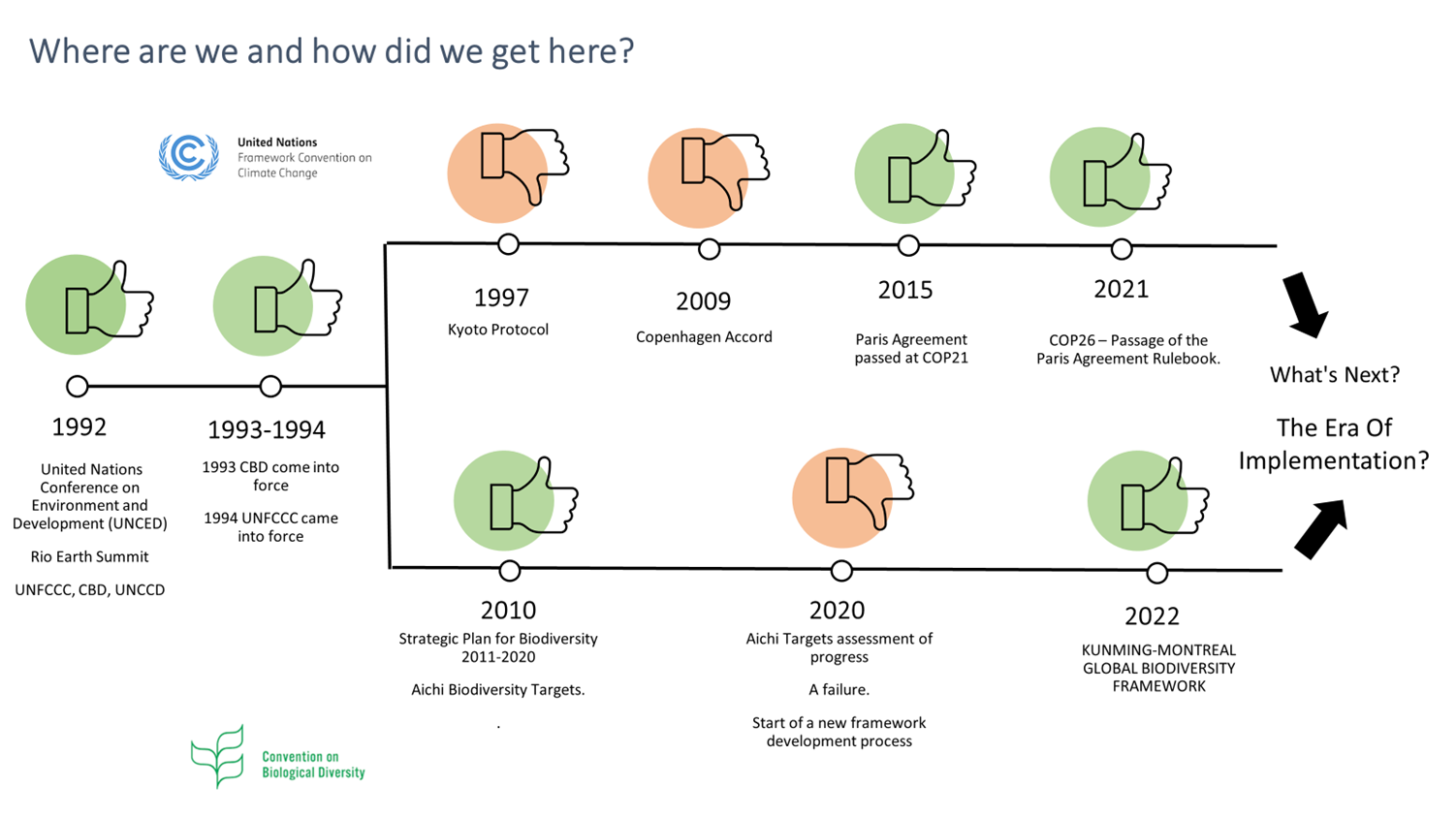
2:09 Interview with Bethan Laughlin on the history of the CBD, UNFCCC and Global Biodiversity Framework
10:02 Nelly Musyoka, ZSL Kenya's Community Liaison Officer, on how the 23 CBD targets are applied to real world conservation
14:39 Bethan Laughlin on what ZSL's priorities are for COP16 in Colombia
23:39 Fiona Dobson, RSPB, on what RSPB's priorities are for COP16 in Colombia
33:18 Outro and further information
Resources
If there's a topic you'd like to hear on a future podcast, or if you'd like to share your thoughts, email the ZSL Wild Science Podcast at: wild.science@zsl.org Check out our science and conservation work at: www.zsl.org/Science or www.zsl.org/conservation Bethan Laughlin: https://www.zsl.org/about-zsl/our-people/bethan-laughlin Watch a recording of our Science and Conservation Event, Putting Nature at the Heart of Global Decision Making: https://www.zsl.org/news-and-events/events/putting-nature-heart-global-decision-making View the infographic depicting successes and failures following the Rio Earth Summit as described by Bethan in this episode: https://cms.zsl.org/sites/default/files/2024-08/CBD%20UNFCCC%20timeline.pngGet in touch
Email wild.science@zsl.org with your questions, comments, and thoughts for future episodes! Tweet us @ZSLScience with the hashtag #ZSLWildScience Follow us on Facebook @ZSLScienceAndConservationWed, 21 Aug 2024 - 34min - 40 - ZSL #041 Reimagining Coral Reefs
Out of sight…but not out of mind? Coral reefs exist largely out of sight for the majority of the world's population, so the vast array of ecosystem services they provide for local communities are often forgotten, leading conservation efforts to feel like an uphill battle. In this episode, we talk to the people trying to tackle this problem; from using the sounds that healthy and degraded coral reefs make to monitor their restoration, to bringing people closer to coral reefs using virtual reality.
Overview
00:13 Introduction to the topic from Harriet McAra
01:26 Ben Williams, PhD student at the Institute of Zoology and UCL, on coral reefs' importance, coral soundscapes and the Mars Assisted Reef Restoration System
08:30 Introduction to the Datascape Realities Project
08:52 John Zhang and Lourenco Viveiros, co-founders of Datascape Realities, and Jason Lynch, UCL and Institute of Zoology
28:14 Outro and further information
Resources
If there's a topic you'd like to hear on a future podcast, or if you'd like to share your thoughts, email the ZSL Wild Science Podcast at: wild.science@zsl.org Check out our science and conservation work at: www.zsl.org/Science or www.zsl.org/conservation Ben Williams: https://www.zsl.org/about-zsl/our-people/ben-williams Mars Assisted Reef Restoration System: https://www.buildingcoral.com/ and https://www.buildingcoral.com/news/mars-data-scientists-turn-their-skills-to-coral-reef-restoration Datascape Realities: https://www.datascaperealities.com/ and @datascape_realGet in touch
Email wild.science@zsl.org with your questions, comments, and thoughts for future episodes! Tweet us @ZSLScience with the hashtag #ZSLWildScience Follow us on Facebook @ZSLScienceAndConservationFri, 14 Jun 2024 - 29min - 39 - ZSL #040 Mammal conservation in Korea: Human-carnivore coexistence on the Korean Peninsula
Co-existence between communities living on the Korean Peninsula and carnivores such as leopards, tigers and black bears, has historically presented many challenges leading to population declines in these species. However, thanks to international treaties such as the Convention on International Trade in Endangered Species, as well as economic growth and conservation translocations, the tide is now turning on these declines in South Korea. In this episode, host Harriet McAra is joined by Joshua Elves-Powell to discuss how wildlife trade has impacted carnivores in East Asia, and the conservation measures being taken to protect these globally threatened species.
Overview
00:20 - Introduction to the topic from Harriet McAra, and introduction to the podcast guest
02:24 - Josh Elves-Powell, PhD student at the Institute of Zoology and UCL, introduction and interview
27:06 - Outro and further information
Resources
If there's a topic you'd like to hear on a future podcast, or if you'd like to share your thoughts, email the ZSL Wild Science Podcast at: wild.science@zsl.org Check out our science and conservation work at: www.zsl.org/Science or www.zsl.org/conservation Joshua Elves-Powell: https://www.zsl.org/about-zsl/our-people/joshua-elves-powell The latest publication from Joshua Elves-Powell, reporting major declines in South Korean big cat trade: https://journals.plos.org/plosone/article?id=10.1371/journal.pone.0299783 Project Moon Bear: https://en.projectmoonbear.org/Mission Korean Tiger and Leopard Conservation Fund: https://blog.naver.com/savetiger Blogs written by Joshua Elves-Powell Asiatic black bear restoration in South Korea: https://theconversation.com/south-korea-is-bringing-back-bears-in-a-country-of-52-million-people-i-went-to-find-out-how-164301 Moves to end bear farming in South Korea: https://theconversation.com/south-korea-to-ban-bear-farming-but-what-to-do-about-hundreds-of-captive-animals-that-remain-197316Get in touch
Email wild.science@zsl.org with your questions, comments, and thoughts for future episodes! Tweet us @ZSLScience with the hashtag #ZSLWildScience Follow us on Facebook @ZSLScienceAndConservationMon, 20 May 2024 - 28min - 38 - ZSL #039 Wild Science is back for 2024
The ZSL Wild Science podcast is back! After a break, we have returned to explore even more topical issues in zoology, conservation and the environment. New host, Harriet McAra, Science Communications and Events Manager at ZSL's Institute of Zoology, will take listeners on a journey to learn more about the incredible science behind ZSL's cutting-edge conservation work.
Resources
If there's a topic you'd like to hear on a future podcast, or if you'd like to share your thoughts any previous episodes, email the ZSL Wild Science Podcast at wild.science@zsl.org Check out our science and conservation work at www.zsl.org/Science or www.zsl.org/conservation Tweet us @ZSLScience with the hashtag #ZSLWildScience Follow us on Facebook @ZSLScienceAndConservationFri, 10 May 2024 - 01min - 37 - ZSL #037 How can we recover nature in our cities: rewilding, reconnecting habitats and restoring rivers
It's no secret that cities are generally perceived as spaces of little conservation relevance, yet local urban wildlife underpins a range of ecosystem services. In a time where rapid changes in the climate are causing more extreme natural events, wildlife is disappearing and we are becoming more and more disconnected from nature through urbanisation, could the recovery of urban ecosystems be a potential solution for a more resilient planet? In this episode, our host Ellie Darbey will discover how we can recover nature in our cities, with ZSL's experts in rewilding, reconnecting habitats and river restoration. Does the answer lie in empowering local communities? Or is it in the plight of the hedgehog? And why must we enact the mysterious Schedule Three?
Guests
Professor Nathalie Pettorelli, Institute of Zoology, ZSL Dr Chris Carbone, Senior Research Fellow, Institute of Zoology, ZSL Joe Pecorelli, Conservation Project Manager, Marine and Freshwater, Conservation & Policy, ZSLOverview
03:31 – Ellie Darbey introduces the first guest, Professor Nathalie Pettorelli to discuss how to rewild in urban environments 16:39 – Ellie is joined by Dr Chris Carbone to talk about the London Hogwatch Project, and their community engagement 26:59 – Species Spotlight: The European hedgehog! 28:12 – Ellie welcomes the final guest Joe Pecorelli to discuss river restoration in London, and the power of the waterways 37:19 – The guests give their answer for the one thing they'd like to change in policy or legislation to help recover urban nature.Resources
If there's a topic you'd like to hear on a future podcast, or if you'd like to share your thoughts on the one change you'd like to see in policy or legislation to help recover nature in cities, email the ZSL Wild Science Podcast at: wild.science@zsl.org Check out our science and conservation work at: zsl.org/Science or www.zsl.org/conservation Living Planet Report: https://www.zsl.org/global-biodiversity-monitoring/indicators-and-assessments-unit/living-planet-index/living-planet Previous Episode mentioned #035 on Nature-based solutions: https://www.zsl.org/zsl-wild-science-podcast Rewilding your cities ZSL report: https://www.zsl.org/science/news/rewilding-our-cities-could-reduce-impacts-of-extreme-weather-says-new-report Rewild my street: https://www.rewildmystreet.org/ London Hogwatch: https://www.zsl.org/conservation/species/mammals/london-hogwatch Pine Marten sighting: https://www.zsl.org/conservation/news/nationally-critically-endangered-pine-marten-spotted-in-london London's Rivers: https://www.zsl.org/conservation/regions/uk-europe/londons-rivers State of the Thames Report: https://www.zsl.org/natureatheart/the-state-of-the-thames-2021 Volunteer for London's Rivers: https://www.zsl.org/conservation/regions/uk-europe/volunteer-for-londons-rivers Flood and Water Management act: https://www.legislation.gov.uk/ukpga/2010/29/contentsGet in touch
Email wild.science@zsl.org with your questions, comments, and thoughts for future episodes! Tweet us @ZSLScience with the hashtag #ZSLWildScience Follow us on Facebook @ZSLScienceAndConservationTue, 20 Dec 2022 - 42min - 36 - ZSL #036 What lies beneath: investigating the amazing world of wildlife pathology
Pathology is the science of diagnosing diseases by observing physical changes in animal cells and tissues, either in living, or more commonly dead animals. In this episode, our host Ellie Darbey will explore the unseen…or rather, unheard world of wildlife pathology with the help of ZSL's experienced pathologists, veterinarians, and scientists. Through post mortems on black widow spiders, to giant stranded humpback whales, these four pathology professionals will show the value of this diagnostic work to the conservation and welfare of animals in zoos and in the wild. What are the practicalities of examining large animals like elephants and rhinos? How can pathology be used to solve wildlife crimes? And what do pathology and The Supreme Court have in common?
Guests
Dr Simon Spiro, Wildlife Health Services, Zoological Society of London Dr Becki Lawson, Institute of Zoology, Zoological Society of London Rob Deaville, Institute of Zoology, Zoological Society of London Dr Tammy Shadbolt, Institute of Zoology, Zoological Society of LondonOverview
01:22 – Ellie Darbey introduces the first guest, Dr Simon Spiro, to discuss what it's like to be a veterinarian pathologist, and how pathology can be used for animal welfare and conservation
14:06 – Ellie is joined by Dr Becki Lawson to explore the Garden Wildlife Health Project and the detective work used to discover a snake fungal pathogen in Europe.
27:15 – Rob Deaville joins to explain what happened to "Hessy" the humpback whale, and how the Cetacean Strandings programme works.
40:10 – Ellie welcomes the final guest Dr Tammy Shadbolt to discuss the Disease Risk Analysis and Health Surveillance Project and how pathology can help solve wildlife crimes.
49:44 – The speakers give their advice for pursuing a career involving wildlife pathology from their varied backgrounds and perspectives.
Resources
Previous ZSL Event "Revealing the unseen: the amazing world of wildlife pathology": https://www.zsl.org/science/whats-on/revealing-the-unseen-the-amazing-world-of-wildlife-pathology Blog: Grass in the Snake - Zoo Pathology in Practice: https://www.zsl.org/blogs/science/grass-in-the-snake-zoo-pathology-in-practice Royal College of Pathologists: Careers in Pathology: https://www.rcpath.org/discover-pathology/careers-in-pathology.html Royal College of Pathologists: Become a Veterinary Pathologist: https://www.rcpath.org/discover-pathology/careers-in-pathology/become-a-veterinary-pathologist.html Garden Wildlife Health Project: gardenwildlifehealth.org UK Cetacean Strandings Investigation Programme (CSIP): https://www.zsl.org/science/research/uk-cetacean-strandings-investigation-programme-csip "Hessy" the humpback whale in the media: https://www.theguardian.com/environment/2019/oct/09/humpback-whale-found-dead-thames-hit-by-ship Collaborative UK Marine Mammals Strandings Project: summary of contaminant data for the period 1993-2001: https://www.cefas.co.uk/publications/techrep/tech131.pdf Disease Risk Analysis and Health Surveillance (DRAHS) Project: https://www.zsl.org/science/wildlife-health/disease-risk-analysis-and-health-surveillance Hazel dormouse 1000th reintroduction: https://www.zsl.org/blogs/science/dormouse-reintroductions--a-landmark-day Study and Research Opportunities at ZSL: https://www.zsl.org/science/postgraduate-studyThu, 09 Dec 2021 - 53min - 35 - ZSL #035 Nature-based solutions - putting nature at the heart of global climate change and biodiversity science-policy agendas
The anthropogenically driven climate crisis and unprecedented rates of biodiversity loss are both threatening the foundations of economies, livelihoods, food security, health and quality of life worldwide. Treating these two crises separately can be ineffectual or even deepen the problem. A recent landmark study calls for a more integrated approach to tackling the climate and biodiversity crises. Ellie Darbey will be joined by lead author of the article, Dr Nathalie Pettorelli, along with three co-authors, to share their expertise on these issues and help untangle the web of science and policy. Why is it important to tackle both these crises together? How can Nature-based Solutions help? And what needs to be done to integrate these solutions into global science-policy agendas?
Guests:
Dr Nathalie Pettorelli, Zoological Society of London Professor Heather Koldewey, Zoological Society of London Professor William Sutherland CBE, University of Cambridge Matthew Lowton, Zoological Society of LondonOverview
01:26 – Ellie Darbey introduces the co-host of this episode, Dr Nathalie Pettorelli, to discuss the climate change and biodiversity crises, and introduce Nature-based solutions (NbS).
12:12 – Ellie and Nathalie are joined by Professor Heather Koldewey to explore the use of protected areas and restoration projects in the marine world.
28:59 – Professor William Sutherland joins to explain how to measure the risks of NbS, and emphasises the importance of evidence-based science policies.
38:42 – Ellie and Nathalie welcome Matthew Lowton to discuss the global conventions for climate change and biodiversity, and the ways to get NbS into science-policy agendas.
Resources
Article: "Time to integrate global climate change and biodiversity science-policy agendas": https://besjournals.onlinelibrary.wiley.com/doi/10.1111/1365-2664.13985 Upcoming live ZSL Event on 12 October: https://www.zsl.org/science/whats-on/time-to-integrate-global-climate-change-and-biodiversity-science-policy-agendas Putting Nature at the heart of global decision making: https://www.zsl.org/natureatheart "Unite solutions to climate and biodiversity crises to save life on earth": https://www.zsl.org/news/unite-solutions-to-climate-and-biodiversity-crises-to-save-life-on-earth-says-zsl-led-study Previous ZSL Event "Nature to get out of the climate crisis - how does that work?": https://www.zsl.org/science/whats-on/nature-to-get-out-of-the-climate-crisis-how-does-that-work Previous Wild Science Podcast Episode "ZSL #028 What's next for rewilding?": https://www.zsl.org/zsl-wild-science-podcast United Nations (UN) Framework Convention on Climate Change: https://unfccc.int/ UN Climate Change Conference of the Parties UK 2021 (CoP 26): https://ukcop26.org/ Convention on Biological Diversity: https://www.cbd.int/ ZSL's Protected Areas and Restoration work: https://www.zsl.org/regions/uk-overseas-territories/chagos-archipelago https://www.zsl.org/conservation/regions/asia/rehabilitating-mangroves-in-the-philippines https://www.zsl.org/conservation/regions/uk-europe/thames-conservation/native-oyster-restoration Conservation Evidence Resource: https://www.conservationevidence.com Book by William J. Sutherland et al. "What Works in Conservation 2021": https://www.openbookpublishers.com/product/1490 Breadth of ZSL's conservation work: https://www.zsl.org/conservation/how-we-workTue, 05 Oct 2021 - 50min - 34 - ZSL #034 Marine habitat restoration in the UK: tales of oysters, saltmarsh, kelp, and seagrass
Coastal marine habitats are essential to the health of our marine ecosystem, and hold both environmental and social importance. They provide valuable ecosystem services, but for decades they have been impacted by harmful human activities. In her final episode as host, Monni Böhm will be joined by co-host Celine Gamble and an expert panel to explore the need for active restoration to conserve four incredible marine habitats: native oyster beds, saltmarshes, kelp forests and seagrass. How can we scale up these restoration efforts? What makes some species in these habitats ecological superheroes? And what on earth is a scuba-diving spider?
Please note: this episode was recorded in 2020.
Guests:
Celine Gamble, Zoological Society of London Dr Joanne Preston, University of Portsmouth Angus Garbutt, UK Centre for Ecology & Hydrology Dr Ian Hendy, The Blue Marine Foundation Dr Richard Unsworth, Swansea University and Project SeagrassOverview
01:06 – Dr Monni Böhm introduces the co-host of this episode, Celine Gamble, to discuss why marine habitat restoration is needed, and introduce the Native Oyster Network.
05:29 – Monni and Celine are joined by Dr Joanne Preston who will discuss the forgotten ecosystem of oyster beds, and how to restore native oyster reefs in the UK.
14:51 – Angus Garbutt describes the diversity of saltmarshes of the UK, provides unique insight into their ecological and cultural importance, and the methods used to restore them.
28:12 – Monni and Celine introduce Dr Ian Hendy who explains what can be done to 'Help our Kelp' and why conserving it is crucial for marine biodiversity in the UK.
39:16 – Dr Richard Unsworth joins the hosts to talk about the importance of seagrasses, and the lessons learned from the UK's first major seagrass restoration project .
Resources
25 Year environment plan: https://www.gov.uk/government/publications/25-year-environment-plan UN decade on Ecosystem Restoration: https://www.decadeonrestoration.org/ Native Oyster Network: https://nativeoysternetwork.org/ Native Oyster Network Habitat Restoration Handbook (November 2020): https://nativeoysternetwork.org/wp-content/uploads/sites/27/2020/11/ZSL00150%20Oyster%20Handbook_WEB.pdf ZSL Native oyster restoration: https://www.zsl.org/conservation/regions/uk-europe/thames-conservation/native-oyster-restoration Twitter: @NativeOysterNet; #OysterLove UKCEH Restoration of coastal habitats: https://www.ceh.ac.uk/our-science/projects/restoration The Saltmarsh App: https://www.saltmarshapp.com/ Blue Marine Foundation Sussex Kelp Project: https://www.bluemarinefoundation.com/projects/sussex-kelp/ Lyme Bay Reserve: https://www.lymebayreserve.co.uk/science/ Research on Kelp and Oyster restoration in Australia: kelp and oyster restoration in Australia? https://besjournals.onlinelibrary.wiley.com/doi/10.1111/1365-2664.13719 Project Seagrass (Seagrass Ocean Rescue): https://www.projectseagrass.org/ Chesapeake Bay Seagrass Restoration: https://www.vims.edu/research/units/programs/sav1/restoration/index.php 750,000 seeds planted in Wales in UK's Biggest Seagrass Restoration Scheme: https://www.swansea.ac.uk/press-office/news-events/news/2020/03/750000-seeds-planted-in-wales-inuks-biggest-seagrassrestoration-scheme-.phpFri, 06 Aug 2021 - 52min - 33 - ZSL #033 Putting reptiles on the map: ZSL Science for reptilian conservation
Reptiles - lizards, snakes, turtles and crocodilians – make up almost one third of all land vertebrate species on Earth, and also occur in many marine and freshwater systems. Yet despite their amazing diversity, reptiles remain hugely underrepresented in conservation research and action, when compared to mammals, birds, and even amphibians. In this episode, our host Ellie Darbey finds out from four fantastic reptile experts how this is changing through increased global efforts to put reptiles on the conservation map. What key advances in species assessments have already made an impact for reptile conservation? How does ZSL's science and conservation work directly contribute to protecting reptiles in the wild? And wait…where is Monni?
Guests:
Dr Monika Böhm, Freshwater Coordinator, Indianapolis Zoo Global Center for Species Survival. Dr Rikki Gumbs, EDGE Postdoctoral Research Scientist, Zoological Society of London. Emmanuel Amoah, Executive Director, Threatened Species Conservation Alliance (THRESCOAL). Benjamin Tapley, Head of the Reptile Team, Zoological Society of London.Overview
01:38 – Ellie welcomes the first guest, Dr Monni Böhm, to discuss how assessments like the IUCN Sampled Red List Index and Global Assessment of Reptile Distributions are essential for advancing the agenda for reptilian conservation.
14:30 – Dr Rikki Gumbs joins the podcast to talk about the reptilian Tree of Life, and the purpose and impact of ZSL's EDGE of Existence programme.
24:08 – Emmanuel Amoah discusses the aims of Ghanaian NGO, THRESCOAL, set up following his EDGE Fellowship, and how community-led conservation can be used to help protect the West African slender-snouted crocodile.
33:32 – Ellie is joined by the final guest, Benjamin Tapley, who provides an overview of the contribution of zoos to conservation in the wild, using the example of the Big-Headed Turtle project in Vietnam.
46:25 – All four guests provide their recommendations for the next step in reptile conservation.
Resources
The IUCN Sampled Red List Index: zsl.org/global-biodiversity-monitoring/indicators-and-assessments-unit/the-sampled-red-list-index Global Reptile Assessment: natureserve.org/conservation-tools/projects/global-reptile-assessment The Global Assessment of Reptile Distributions: gardinitiative.org/ Indianapolis Zoo: indianapoliszoo.com/conservation/ ZSL's EDGE of Existence Programme: edgeofexistence.org/ Imperial College London's Grantham Institute: https://granthaminstitute.com/ THRESCOAL: threscoal.org/ Emmanuel's ZSL EDGE project page: edgeofexistence.org/fellow/emmanuel-amoah/ ZSL London Zoo Reptile House: zsl.org/zsl-london-zoo/exhibits/reptile-house ZSL online Science and Conservation Event: zsl.org/science/whats-on/putting-reptiles-on-the-map-zsl-science-for-reptilian-conservation Related ZSL Wild Science podcast episodes: zsl.org/zsl-wild-science-podcast #007: Ten years on the EDGE of Existence #010: Species in the red: behind the scenes of the IUCN Red List #015: Biodiversity indicators: getting the measure of biodiversity and what it all meansWed, 19 May 2021 - 49min - 32 - ZSL #032 Coral reefs: running the gauntlet of climate change
Coral reefs are the most biodiverse marine ecosystems in the world, and more than 500 million people worldwide rely on coral reefs for their livelihoods, food security, and coastal protection. However, coral reefs are impacted by several threats, including rises in sea-surface temperature due to climate change. Join Monni as she navigates these unique underwater ecosystems with the help of five fantastic coral connoisseurs. How can new technologies be used to protect and preserve coral reefs for the future? Why is connectivity important? And which fascinating fact will make your brain (coral) explode?
Guests:
Dr Catherine Head, Institute of Zoology, ZSL and University of Oxford Dr Jamie Craggs FLS, Horniman Museum & Gardens and Natural History Museum, London Dr James Guest, Newcastle University Dr Rosa van der Ven, Wageningen University Dr Chris Yesson, Institute of Zoology, ZSLOverview
01:05 – Monni is joined by the co-host of this episode, Dr Catherine Head, an expert in applied ecology and evolution in marine ecosystems, particularly coral reefs, and how tools like population genetics can help conserve them.
05:29 – First up, Monni and Catherine welcome Dr Jamie Craggs, to discuss how captive breeding techniques in aquaria can be used for coral conservation.
14:40 – Dr James Guest joins the podcast to talk about his work with 'Coral Assist', a project which examines the feasibility of using "assisted gene flow" and selective breeding to assist corals in the face of climate change.
24:14 – Dr Rosa van der Ven discusses genetic connectivity of corals between reefs, and explains why connectivity is important for their conservation.
30:52 – Monni and Catherine are joined by their final guest, Dr Chris Yesson, cold water coral expert, to discuss how genetic techniques like coral barcoding are used to identify corals in aquaria, and how this can be useful coral conservation.
Resources
Project Coral: https://www.horniman.ac.uk/project/project-coral/ Coral Assist: https://www.coralassistlab.org/ ZSL Wild Science Podcast #011 Can we still save coral reefs and what if we don't?: https://www.zsl.org/zsl-wild-science-podcast ZSL's work with coral reefs in the Chagos Archipelago: https://www.zsl.org/regions/uk-overseas-territories/chagos-archipelago Bertarelli Foundation: https://www.fondation-bertarelli.org/Hosted and edited by Dr Monni Böhm, ZSL Research Fellow, and produced by Eleanor Darbey, ZSL Scientific Events Coordinator.
Thu, 01 Apr 2021 - 42min - 31 - ZSL #031 Habitat loss and human health – understanding the links between ecosystem degradation and infectious disease outbreaks
After more than a year of Covid-19 impacting global populations, health systems and economies, one of the major questions being asked was how did this start, and how can we prevent it from happening again? As we humans increasingly disturb our planet's natural habitats and convert them to agricultural and urban areas, the way we interact with wildlife around us also changes. In this episode, Monni turns to a team of experts in wildlife diseases, to discuss this link between ecosystem degradation and infectious disease outbreaks. What makes an animal a good host for carrying zoonotic diseases? Can we predict and prevent infectious disease outbreaks in the future? And exactly what does a job as 'human bait' entail?
Guests:
Dr Rory Gibb, London School of Hygiene and Tropical Medicine Dr Christina Faust, Pennsylvania State University Dr Kimberly Fornace, London School of Hygiene and Tropical MedicineOverview
01:40 Monni welcomes Dr Rory Gibb, to discuss zoonotic hosts and their response to land-use change, and how we should move forward to help human health in the future.
18:28 Dr Christina Faust joins Monni to explore disease transmission, explaining where transmission is more likely to happen in different types of landscapes, and how this could be tracked to avoid future outbreaks in humans.
28:43 Monni is joined by the final guest, Dr Kimberly Fornace, to discuss the Monkey Bar project, and how different technologies such as drones and radio collars were used to monitor monkey malaria.
Hosted by Dr Monni Böhm, ZSL Research Fellow and produced by Eleanor Darbey, ZSL Scientific Events Coordinator.
Thu, 04 Mar 2021 - 38min - 30 - ZSL #030 Can surveillance technology and social science address rule-breaking and wildlife crime?
Law breaking, such as poaching or fishing inside marine reserves, is a great challenge to conservationists because research is often complicated by ethics and data privacy. However, important technological progress has been made in recent years, especially in the fields of surveillance and vessel tracking. Join Monni as she finds out from a panel of experts how machine learning and technology developments in drones, infrared imaging, global positioning systems and cameras can help tackle wildlife crime. How can social science help us understand the motivations behind rule-breaking? And what rule is Monni so afraid of admitting that she once broke?
Guests:
Dr Tom B Letessier, Research Fellow at the Institute of Zoology, ZSL Dr Kristina Boerder, Postdoctoral Fellow at the Dalhousie University Professor Serge Wich, Liverpool John Moores University Dr Colin Beale, Reader at the University of York Dr Ana Nuno, NOVA University Lisbon and University of ExeterOverview
00:53 - Monni is joined by the co-host of today's episode, Dr Tom B Letessier, an expert in the use of drones and other technologies for marine protected area (MPA) surveillance, fisheries enforcement and megafauna monitoring.
03:49 - Monni and Tom welcome Dr Kristina Boerder to discuss the use of automatic identification systems (AIS) to track illegal activity of fishing vessels in MPAs.
17:48 - Professor Serge Wich joins the hosts to take the surveillance discussion on land, using drones and infrared cameras in tropical terrestrial ecosystems.
24:35 - Dr Colin Beale discusses how to tackle wildlife crime in Africa using algorithms to analyse evidence of illegal activity in the bush and inform ranger-led patrols.
33:44 - Monni and Tom are joined by their final guest, Dr Ana Nuno, to find out how social science can address rule breaking in conservation.
Resources:
Guardian article on the use of technology to stop illegal trade: https://www.theguardian.com/environment/2019/dec/08/wildlife-trafficking-science-technology-come-to-rescue-end-illegal-trade Guardian article on drones and big datat: https://www.theguardian.com/education/2019/feb/18/drones-and-big-data-the-next-frontier-in-the-fight-against-wildlife-extinction Global Fishing Watch: https://globalfishingwatch.org/ Link to New York Times article on Palau vs the Poachers: https://www.nytimes.com/2016/02/21/magazine/palau-vs-the-poachers.html Review of the Outlaw Ocean book: https://www.theguardian.com/books/2019/oct/02/the-outlaw-ocean-by-ian-urbina-reviewTue, 02 Feb 2021 - 47min - 29 - ZSL #029 The future of biodiversity conservation - different dimensions of conservation thinking
Conservationists are working hard to stem global biodiversity loss. Yet, just like biodiversity itself, the conservation movement is very diverse, with a variety of ideas shaping its framing, purpose and application. In this episode, Monni and co-hosts Yara Shennan-Farpón, Helen Muller and Thalassa McMurdo Hamilton, speak with Dr Chris Sandbrook, co-creator of the Future of Conservation Survey, about some of the lessons learned from analysing the perspectives of nearly 10,000 conservationists from around the world. What could the future of conservation look like? And what would need to happen for us to get there?
Take the survey to find out and reflect on where you think the future of conservation lies: https://www.futureconservation.org/
Tue, 22 Dec 2020 - 43min - 28 - ZSL #028 What's next for rewilding?
Rewilding has emerged as a captivating, but controversial, concept in conservation. Depending on how rewilding is defined, it aims to increase "wildness" of nature, regenerate ecosystem functioning, develop self-sustaining ecosystems, or a combination of these. Join Monni as she finds out from the experts how real "wildness" can be achieved, and why now is an important time for the UK to be thinking about rewilding. What is even possible in places like the UK where we have quite limited space? Should people be part of rewilding? And why can the Tamworth Pig be considered the hippopotamus of the UK?
Fri, 11 Dec 2020 - 47min - 27 - ZSL #027 Madagascar's missing megafauna: life after lemurs, hippos and elephant birds
Madagascar is famed for its incredible biodiversity and charismatic lemurs, but has also seen extensive loss of natural habitat. Monni finds out from a panel of Madagascar aficionados what the island has been like in the past and what the challenges are for its surviving wildlife. How big is an elephant bird and its poo? What can old bones tell us? What are the ups and downs of conservation efforts on Madagascar? And why is the Madagascar pochard such a special bird?
This episode was recorded in November 2019
Thu, 14 May 2020 - 44min - 26 - ZSL #026 Shifting tides: how can small-scale fisheries help address the Sustainable Development Goals?
Small-scale fisheries (SSFs) provide around two-thirds of the world's catch intended for human consumption, and support 90% of employment in the fisheries sector, therefore should have a huge role to play in achieving some of the Sustainable Development Goals (SDGs). Despite this, they are barely mentioned. Monni finds out from a panel of SSF a-fish-ionados why SSFs are being overlooked, what we can learn from them, and how we can better incorporate SSFs into policy, to meet human needs while safeguarding marine biodiversity. But where does gender come into this? And what is this creature that breeds like a plant but feeds like a carnivore?
Mon, 10 Feb 2020 - 43min - 25 - ZSL #025 Can badger vaccination help eradicate bovine TB?
For decades, conservationists, vets and farmers in the UK have been at loggerheads about the best way to manage bovine tuberculosis (bTB). This cattle disease is a huge burden on the farming industry and can pass between cattle and badgers, making it difficult to eradicate. In this episode, Monni teams up with bTB & badger specialists, to discuss badger vaccination as an alternative to culling operations - the current approach to controlling the disease in England. How do the two approaches compare in terms of effectiveness, practicality and cost? How can the disease be eradicated? And what on earth is a Goodger©?
Thu, 12 Dec 2019 - 43min - 24 - ZSL #024 Street-smart animals - incorporating cognitive behaviour into conservation efforts
Human-induced urbanisation, invasive species and land clearing are changing the environment at a far quicker pace than animals are able to evolve. Cognitive mechanisms can play a crucial role in determining how well animals adapt to this change. In this episode, Monni and a team of experts explore how integrating cognitive mechanisms into conservation strategies offers a new approach to enable animals to adapt and survive. How can cognition play a role in caring for our animals at ZSL London Zoo? Why do some baboons think they're being stalked? And will Monni ever learn?
Mon, 25 Nov 2019 - 36min - 23 - ZSL #023 Indigenous knowledge and conservation management: challenges and opportunities
Indigenous communities around the world possess an extremely rich body of knowledge about local environmental resources and biodiversity, which has the potential to be an invaluable conservation tool. However, this local ecological knowledge is being progressively eroded worldwide. Hear Monni and a diverse panel of experts discuss the challenges and opportunities for incorporating indigenous knowledge into conservation management. How can social science help? And why should more trees be ordained as monks?
*Listener note: we apologise for the variety in sound quality on this episode, we experienced some technical issues during recording.
Fri, 18 Oct 2019 - 45min - 22 - ZSL #022 Can we find better ways to live with wildlife?
People and nature depend on each other, and although humans are needed to manage and protect nature, conservation practices can interfere with human livelihoods and create conflict between groups of people with competing interests. In this episode our guest host Charlotte Coales teams up with four experts to explore the complexity of these conflicts. What are the underlying drivers? Why do conservationists need to brush up on their people skills? And how could consensus building help?
Mon, 05 Aug 2019 - 39min - 21 - ZSL #021 World Swallowtail Day
June 9th is World Swallowtail Day, and what better way to celebrate than with a trip to ZSL's Butterfly Paradise to marvel at swallowtails, their bird poo mimicking larvae and get a good sniff of the osmeterium. The what? Find out in this episode, where Monni and guests discuss important conservation work for swallowtails at home and abroad, learn about butterfly houses and ZSL's ongoing work assessing the status of swallowtails worldwide, and are introduced to the Dance of the Golden Birdwing. Happy World Swallowtail Day!
Thu, 06 Jun 2019 - 30min - 20 - ZSL #020 Marine plastic pollution: the science story
Hold your breath while we remain underwater for this next episode - Monni and a team of specialists investigate the science behind marine plastic pollution. What are the impacts of plastic on wildlife, people and our coasts? What are the future avenues for tackling this issue? What can each one of us do to reduce single-use plastic in our everyday lives? And how many washing machines can you fit into one small laboratory?
Fri, 17 May 2019 - 38min - 19 - ZSL #019 How electronic animal tracking has revolutionised marine conservation
The marine environment is vast and until recently its sheer size and inaccessibility have hindered our ability to understand the impacts of environmental changes on marine life. Monni and a team of marine wildlife experts reveal how advances in electronic tracking equipment have allowed us to remotely monitor marine animals. How do you tag marine animals? What are the challenges we face when using tagging equipment in the marine environment? How can this help to improve conservation management? And fin-ally, why are plungers and egg timers involved?
Wed, 24 Apr 2019 - 39min - 18 - ZSL #018 Rewilding in a changing climate
Conservation often tries to restore habitats to what they were - but given that our climate is changing fast, this kind of ecosystem restoration may no longer be possible. Monni and guests explore how rewilding can help build resilient ecosystems for the future. Why is rewilding often so contentious? How can it be applied to help threatened species? Can humans derive benefits from rewilding? And how do classic cars come into all of this?
Wed, 27 Feb 2019 - 36min - 17 - ZSL #017 Giving animals choice: how our zoo keepers use science to positively impact animal welfare
Monni teams up with ZSL's Behavioural Management Committee (BMC) to find out how giving animals choice positively enhances their welfare and how this is put into practice every day at our zoos. What is the BMC and what happens at 'enrichment evenings'? How do you assess the welfare needs of an ant? How long does it take a gorilla to solve a puzzle and how does behavioural management in our zoos benefit research projects in the wild? And finally... does 'positive reinforcement' also work on Monni?
Thu, 31 Jan 2019 - 33min - 16 - ZSL #016 Wildlife and wellbeing in urban landscapes
Nearly half of the world's human population lives in urban environments and this is projected to increase in future. While many species suffer the effects from urbanisation, other species thrive (or at least persist) in our urban landscapes. Monni and guests explore what creatures are lurking in our cities at night, how we can improve our urban landscapes for nature and our own well-being and what you should (and shouldn't) do when you find a camera trap in a park.
Mon, 10 Dec 2018 - 20min - 15 - ZSL #015 Biodiversity indicators: getting the measure of biodiversity and what it all means
Monni explores the ins and outs of biodiversity indicators with IOZ's Indicator and Assessments Research Unit. Biodiversity indicators are measures of how biodiversity is doing worldwide, and we see them reported in the media: the Living Planet Index, for example, was recently published as part of the 2018 Living Planet Report and shows that populations of vertebrates (mammals, birds, amphibians, reptiles and fish) have decline on average by 60% since 1970. How do such metrics come about and why do we need them? What are their strengths and weaknesses? Who are the people behind these biodiversity indicators? And… are spiders "huggable"? You've come to the right place to find out.
Tue, 13 Nov 2018 - 33min - 14 - ZSL #014 A new era for shark conservation? Protecting 'flat sharks', rays and angels
Monni and guests explore a new era of shark conservation, focusing on protecting the lesser-known 'flat sharks' and rays, such as sawfishes, angel sharks, wedgefishes stingrays and guitar sharks. Large coastal sharks have a greater exposure to habitat degradation and fishing compared to offshore and pelagic species, increasing their risk of extinction. Find out what mermaids' purses tell us about the current distribution of these flat sharks, which include angel sharks living in the Canary Islands and around Welsh coast.
Wed, 03 Oct 2018 - 25min - 13 - ZSL #013: Cetacean by-catch: casting the net for solutions
By-catch is defined as the accidental entanglement of non-target species in fishing gear and is a principal cause of strandings for cetaceans. Monni is joined by researchers from the Cetaceans Strandings Investigations Programme (CSIP) and its partners to discuss by-catch as both a welfare and a conservation issue. With the scale of fishing in global oceans increasing, what solutions are available to reduce the impact of by-catch on cetacean populations around our shores?
Fri, 07 Sep 2018 - 27min - 12 - ZSL #012: ZSL at the Royal Society Summer Science Exhibition 2018
In this special mini-episode join Monni at the Royal Society Summer Science Exhibition for a teaser of what our researchers will be talking on our ZSL stand 'Where the Wild Things Are'. Learn about the camera traps, tags and trackers being deployed around the world to study and monitor wildlife in remote locations, and what we can learn from the data they capture. Find out why should come along to the exhibition and what you can see and do at our exhibit, from animal top trumps, a cuddly shark, display camera traps and trackers, and an interactive game flapping an albatross!
Wed, 04 Jul 2018 - 13min - 11 - ZSL #011 Can we still save coral reefs?
Monni is joined by co-presenter Rachel Jones to navigate the hot waters of threats to coral reefs. Speakers discuss their experiences and stories from over 30 years' of research into the beauty and importance of these bio-diverse ecosystems. Even away from direct threats such as pollution, the protected reefs of the Chagos Archipelago in the British Indian Ocean Territory have recently been severely damaged by widespread bleaching events. Can the reefs bounce back? What research is being done to find out more about them, and why is it so important to take action now?
Tue, 26 Jun 2018 - 28min - 10 - ZSL #010: Species in the red: behind the scenes of the IUCN Red List
We have probably all heard about threatened species that are close to extinction, but how do we measure this? Monni travels to the IUCN Red List Unit in Cambridge to find out about the ins and outs of the IUCN Red List of Threatened Species, the world's most comprehensive inventory of the extinction risk of species. How do we measure extinction risk? Who compiles the Red List and why? Which species have been assessed, what data do we need and where are the main data gaps? And what has Frank Zappa got to do with it all? Find out more about this flagship conservation tool and the people who eat, sleep and breathe the IUCN Red List.
Wed, 30 May 2018 - 38min - 9 - ZSL #009: Collaborating for conservation in China
This episode is hosted by guest presenter Charlotte Coales, Public Engagement with Conservation Science Coordinator at ZSL. Charlotte and co-presenter Heidi Ma explore wildlife in China, a vast 'megadiverse' country that contains over 10% of global mammal species. From addressing pangolin trade for traditional Chinese medicine to protecting the beautiful and mysterious snow leopard, find out about the collaborative conservation projects stretching across China's wide range of ecosystems.
Fri, 20 Apr 2018 - 24min - 8 - ZSL #008: Reintroductions for saving species – meet the wildlife movers
Monni is joined by co-presenter Helen Gath to navigate the topic of reintroduction, an effective but complex conservation tool that can help save small populations of species. Speakers discuss how difficult reintroduction decisions are made in order to manage the risks and competing stakeholder interests involved, They discuss Helen's work on Mauritius, beavers in Scotland and Yellowstone's 'nervous elk'!
Tue, 17 Apr 2018 - 33min - 7 - ZSL #007: Ten years on the EDGE of Existence
Monni is joined by co-presenter Claudia Gray to celebrate the 10-year anniversary of ZSL's EDGE of Existence Programme. This unique conservation programme aims to save wildlife that's Evolutionary Distinct and Globally Endangered, including the Chinese giant salamander, clawed frog and long-beaked echidna. Guests delve into the Tree of Life to explore these weird and wonderful species, which currently represent some of life's oldest and most threatened lineages. Learn about the work being done across the globe to ensure their survival.
Mon, 26 Feb 2018 - 24min - 6 - ZSL #006: Wildlife of the West African Savannah: unfamiliar and under threat
The West African Savannah stretches 1,600,000 square kilometres across 12 countries, ranging from dense rain forest to arid grassland. It once hosted rhinos, giraffes, lions and other charismatic megafauna more familiar from East African safaris, but populations have declined over the last 40 years. Despite working in an area of economic pressure and political unrest, Monni's guests celebrate conservation projects that work with governments and local communities across national boundaries to conserve the region's remaining cheetahs, wild dogs, and remarkable 'desert-adapted' elephants.
Fri, 09 Feb 2018 - 19min - 5 - ZSL #005: The state of the Thames
Since being declared 'biologically dead' in 1958, the River Thames is now considered a global conservation success story of a recovering urban estuary. Monni talks to guests working on a range of conservation projects by researchers and citizen scientists in the heart of London, including juvenile fish surveys, seal counts and 'outflow safaris'. Find out more about the diverse range of species now living in the Thames' muddy waters.
Thu, 01 Feb 2018 - 21min - 4 - ZSL #004: Conserving the mountain chicken frog: understanding and mitigating an amphibian disease outbreak
The mountain chicken frog became critically endangered after an outbreak of the amphibian fungal disease chytridiomycosis, which caused an 85% decline in population on its home island of Dominica, and near extinction on the neighbouring island of Montserrat. Monni is joined by a team from the Mountain Chicken Recovery Programme working in ZSL London Zoo and out in the field to understand the disease and its impacts. By monitoring the outbreak as it happened, what can be learned to inform future conservation management and restore the mountain chicken to its native habitat?
Thu, 01 Feb 2018 - 24min - 3 - ZSL #003: Saving pangolins: Earth's most trafficked wild mammals
To mark World Pangolin Day, Monni and guests discuss the plight of pangolins: the odd-looking scaly-anteater victims of an illegal wildlife trade that has brought them to the brink of extinction. Although they are severely threatened, a growing conservation movement is working to prevent poaching, limit trafficking and change consumer behaviour, with the aim of tipping the scales back in the pangolin's favour.
Thu, 01 Feb 2018 - 21min - 2 - ZSL #002: Fishing in the Arctic - is there a sustainable approach?
In our second episode, we discuss the northern ocean, which has only recently become accessible after the retreat of Arctic ice. Fishing vessels, including destructive bottom trawlers, can now venture further north than ever before into previously un-fished waters. Monni Böhm is joined by guests to explore the potential value of marine reserves, consumer pressure, certification schemes and scientific understanding as strategies for managing future marine exploitation.
Thu, 01 Feb 2018 - 22min - 1 - ZSL #001: Can I protect the planet? How our daily decisions impact biodiversity decline
In this first episode of the ZSL Wild Science podcast, we interview speakers taking part in a debate at the Zoological Society of London: 'Global biodiversity decline is not impacted by my daily decisions'. Join presenter Monni Böhm, a research scientist in ZSL's Institute of Zoology, to discuss whether the problem of declining biodiversity requires global-scale political, technological and economic solutions, or whether individuals can make a difference.
Thu, 01 Feb 2018 - 20min
Podcasts similares a ZSL Wild Science Podcast
 El Partidazo de COPE COPE
- Herrera en COPE COPE
- Es la Mañana de Federico esRadio
- La noche de Cuesta esRadio
- La Trinchera de Llamas esRadio
- Hondelatte Raconte Europe 1
- Affaires sensibles France Inter
- LEGEND Guillaume Pley
- Second Wave KUOW News and Information
- Marketplace Marketplace
- El colegio invisible OndaCero
- La Rosa de los Vientos OndaCero
- Les grands dossiers de l'Histoire par Franck Ferrand Radio Classique
- Espacio en blanco Radio Nacional
- Entrez dans l'Histoire RTL
- Le grand récit RTL
- Les Grosses Têtes RTL
- L'Heure Du Crime RTL
- El Larguero SER Podcast
- Nadie Sabe Nada SER Podcast
- SER Historia SER Podcast
- Todo Concostrina SER Podcast
- Un Libro Una Hora SER Podcast
- The Megyn Kelly Show SiriusXM