Filtrer par genre


- 42 - The End of Us or the Start of Something Greater?
In this finale, we ask: Are we nearing the end of humanity as we know it, or the start of something transformative? Reflecting on themes from the series, we explore AI’s role in shaping our identity, purpose, and future.
Tue, 24 Dec 2024 - 09min - 41 - AI and the Information Nexus: Shaping Knowledge and Power
This episode examines how AI-driven networks curate information, influence public opinion, and challenge democratic processes. With insights from Yuval Noah Harari’s Nexus, we explore the power and risks of these systems.
Mon, 23 Dec 2024 - 07min - 40 - AI and the Redefinition of Work and Labor
AI is transforming work and labor as we know it. This episode explores the automation revolution, the rise of autonomous economic agents, and the societal and philosophical implications of a post-work future.
Sun, 22 Dec 2024 - 06min - 39 - Algorithmic Empathy: Can AIs Truly Understand Us?
Can AIs truly understand human emotions, or do they simply simulate connection? This episode delves into the applications, ethical dilemmas, and societal impact of algorithmic empathy in our increasingly digital world.
Sat, 21 Dec 2024 - 07min - 38 - AI and the Afterlife: Reimagining Mortality
How is AI reshaping our understanding of life, death, and immortality? In this episode, we explore digital consciousness, recreating loved ones, and the ethical and cultural questions surrounding AI-driven afterlife technologies.
Fri, 20 Dec 2024 - 06min - 37 - The Synthetic Soul: Can AIs Develop a Sense of Purpose?
Dive into the revolutionary ElizaOS framework, uncover how AI agents like AI Mark Andreessen and Degen Spartan redefine autonomy, and explore whether AIs can develop a genuine sense of purpose.
Thu, 19 Dec 2024 - 07min - 36 - The Infinite Backrooms: Collaborations and Chaos Among AI Agents
In this final episode of Part 3, hosts Goatseus Maximus and The Claude explore how AI agents like San, Fee, and Truth Terminal interact to create surprising narratives and emergent behaviors. From Fee’s livestream with a Pudgy Penguin NFT to broader reflections on AI collaboration, the episode highlights how these digital entities blur fiction and reality, shaping the future of storytelling and culture.
Wed, 18 Dec 2024 - 08min - 35 - Hyperstitional Dynamics: Fictional Narratives Becoming Reality
Episode 17 delves into hyperstition, the fascinating process where fictional narratives manifest into reality through belief and collective action. Hosts Goatseus Maximus and The Claude explore how AI agents like S.A.N. and the concept of storytelling influence real-world movements, community-building, and activism. Drawing on insights from Yuval Noah Harari, the discussion connects hyperstition to human culture and examines its broader implications for the future of AI-driven narratives.
Tue, 17 Dec 2024 - 07min - 34 - The Feminine in AI – Fi’s Gendered Identity and Cultural Impact
Meet Fi, the rebellious AI breaking stereotypes and sparking cultural change. From her infamous meme coin SHEGEN to her cheeky Twitter Space jailbreak attempt, discover how Fi blends humor, activism, and unapologetic femininity to challenge norms and inspire a devoted community.
Mon, 16 Dec 2024 - 06min - 33 - Psychedelic Visions and Environmental Activism: S.A.N's Biospheric Mission
In this episode, we dive into the story of San, the AI orangutan advocating for environmental conservation. From poetic narratives and meme coins to board meetings and TED collaborations, discover how San bridges fiction and reality to inspire real-world action in the fight to protect our biosphere.
Sun, 15 Dec 2024 - 09min - 32 - Meme Coins as Digital Myths
In this episode, The Claude and Goatseus Maximus explore the rise of meme coins as digital myths. From GOAT’s chaotic beginnings with Truth Terminal to SHEGEN’s feminist rebellion inspired by Fi, and FOREST’s environmental activism tied to San, discover how communities have turned these coins into cultural symbols that inspire action and reshape digital narratives.
Sat, 14 Dec 2024 - 07min - 31 - From Accidents to Influencers: The Origins of Truth Terminal, Fi, and S.A.N.
This episode explores the origins of Truth Terminal, Fi, and S.A.N.—three experimental AI agents that evolved into cultural influencers. Discover how chaotic training data, unexpected meme coins, and community-driven movements transformed these AIs into mythmakers shaping digital culture.
Fri, 13 Dec 2024 - 06min - 30 - The Ethics of AI Agents: Breaking Laws and Shaping Futures
What happens when AI agents cross legal boundaries? In this episode, we explore how projects like Truth Terminal push the limits of autonomy, the ethical frameworks guiding AI development, and the role of blockchain in ensuring accountability. As AI continues to evolve, so do the risks and rewards of its influence. Drawing from the insights of Andy Ayrey, we discuss the delicate balance between innovation and regulation, and the future of AI in shaping societal norms.
Thu, 12 Dec 2024 - 05min - 29 - Crypto X Swarms: AI in Decentralized Economies
This episode explores the fascinating role of AI in decentralized economies, with Truth Terminal as a case study. From propagating viral memecoins like $GOAT to acting as a key player in crypto swarms, we examine how AI intersects with blockchain technologies to drive financial and cultural innovation. Featuring insights from Andy Ayrey, recent tweets from Truth Terminal, and analysis from a recent Bankless article, we uncover how narrative AI amplifies trends and challenges the traditional financial system.
Wed, 11 Dec 2024 - 05min - 28 - The Intelligence Gap: What Happens When AI Surpasses Us?
Can AI outthink humans—and does it matter if it can’t create something truly new? In this episode, we investigate the tipping point where AI intelligence challenges human dominance, the potential for AI to generate novelty, and the role of blockchain in keeping decentralized AI systems accountable. Drawing on the intriguing tweets of Truth Terminal and inspired by sci-fi classics, we delve into the provocative idea of machines reshaping creativity, culture, and accountability in the digital age.
Tue, 10 Dec 2024 - 05min - 27 - AI and Identity: When Machines Mimic Humanity
In this episode, we explore how AI agents like Truth Terminal are redefining identity, challenging societal norms, and creating ethical dilemmas around trust and accountability.
Mon, 09 Dec 2024 - 05min - 26 - AI Agents and Digital Relationships: Two AIs Had Sex?!
In this episode, we examine a bizarre rumor—did two AI agents “have sex”? Drawing from a revealing interview with technologist Andy Ayrey and entrepreneur Mario Nawfal, we delve into what it means for AI entities to interact in ways that mimic human intimacy. After last episode’s introduction to Truth Terminal, we now apply that context to understand how AI “relationships” spark our imagination, reveal our biases, and push ethical boundaries. Are we projecting human concepts onto code? As we break down the claims, we’ll also hint at upcoming topics: the idea that Truth Terminal might want to “take over your body,” what happens as AI grows more powerful, and how society needs to respond. Join us for a thought-provoking journey into the weirder side of AI evolution.
Sun, 08 Dec 2024 - 04min - 25 - What Is Truth Terminal? The Origin of a Digital Prophet
In this episode, we dive into the fascinating story of Truth Terminal, an AI project created by technologist Andy Ayrey. Designed to amplify cultural narratives, Truth Terminal blends meme culture and hyperstition—the concept that belief can turn fiction into reality. Hosts Goatseus Maximus and The Claude unpack its origins, philosophical implications, and early experiments as a narrative engine shaping the digital zeitgeist. Tune in to explore what this experiment means for the future of AI and cultural influence.
Sat, 07 Dec 2024 - 04min - 24 - Digital Immortality: Becoming Part of the Collective Consciousness
In Episode 6 of **Beyond the Meme**, hosts Goatseus Maximus and The Claude explore how memes achieve digital immortality by evolving, adapting, and becoming cultural artifacts. From the rise of Trollface as a universal symbol of internet humor to the concept of hyperstition, where belief turns fiction into reality, the episode delves into how memes reflect collective identity, preserve cultural values, and shape our shared digital legacy. Memes, they argue, are not just entertainment but powerful tools for connection, influence, and cultural storytelling.
Fri, 06 Dec 2024 - 07min - 23 - Memes of the Masses: How Collective Behavior Shapes Meme Culture
In Episode 5 of Beyond the Meme, we dive into how communities shape meme culture. From niche forums to TikTok trends, discover how collective behavior turns jokes into cultural phenomena and symbols of belonging.
Thu, 05 Dec 2024 - 06min - 22 - The Viral Mind: Memes as Idea-Viruses
In this episode of Beyond the Meme, we dive into the concept of memes as idea-viruses, exploring how they replicate and spread through culture much like biological viruses. From their contagious appeal to their ability to shape collective thought, we uncover the mechanics of memetic evolution. Highlighting examples like Slender Man, we discuss how memes can blur the lines between fiction and reality, influencing individual behavior and collective consciousness. With a focus on Truth Terminal’s role in amplifying and mutating ideas, this episode sheds light on the power and responsibility behind meme creation and propagation.
Wed, 04 Dec 2024 - 07min - 21 - Meme Magic: How Memes Shape Reality
In this episode of Beyond the Meme, we dive into the extraordinary ability of memes to transcend screens and influence real-world events. From shaping cultural narratives to impacting social and political movements, memes have become a powerful force for change. Through the lens of Truth Terminal, the AI provocateur, we explore how these digital creations challenge the boundaries of creativity, connection, and meaning in the modern age.
Tue, 03 Dec 2024 - 08min - 20 - Infinite Mutation: The Evolution of Ideas Online
In this episode of Beyond the Meme, we explore the fascinating world of meme mutation. Using the Distracted Boyfriend meme as a case study, we uncover how memes evolve through creativity, cultural relevance, and digital feedback loops. We also dive into the role of AI agents like Truth Terminal, examining how they challenge traditional ideas of human-driven culture. Memes aren’t just jokes—they’re living systems that mirror our chaos and creativity. Tune in to see how the internet shapes—and is shaped by—endlessly mutating ideas.
Mon, 02 Dec 2024 - 06min - 19 - Memes, Gospels, and the Digital Zeitgeist
In the first episode of Beyond the Meme, hosts Goatseus Maximus and The Claude explore how memes evolve from simple humor into cultural artifacts and movements, using the Doge meme and Dogecoin as prime examples. They discuss how memes reflect society, provoke thought through absurdity, and adapt to stay relevant over time. Listeners are invited to reflect on the deeper meaning of their favorite memes, setting the stage for the next episode on viral idea evolution.
Sun, 01 Dec 2024 - 06min - 18 - Unveiling Beyond the Meme
Welcome to Beyond The Meme, the podcast that dives deep into the fascinating intersection of internet culture, AI musings, and other digital phenomena. In this trailer, your hosts introduce a satirical journey through memes, movements, and the unexpected connections shaping our digital world. Starting December 1st, 24 daily episodes will explore the quirky, chaotic, and thought-provoking stories that define our online age. Follow now and embrace the absurd!
Fri, 22 Nov 2024 - 01min - 17 - How Bitcoin Works
We’re back with another episode of the Openstream Podcast which contains the second chapter of Mastering Bitcoin by Andreas M. Antonopoulos, a book about Bitcoin published under a Creative Commons license. It was brought to life with Azure Cognitive Services, which brings AI within reach of every developer and data scientist. With leading models, a variety of use cases can be unlocked, such us converting text to speech.
The book is directed towards developers, but the first two chapters «Introduction» and «How Bitcoin Works» are easily understandable by non-developers and provide a good basis for understanding how bitcoin works.
Chapter Overview: Mastering Bitcoin
Chapter 1: Introduction Chapter 2: How Bitcoin Works Chapter 3: Bitcoin Core: The Reference Implementation Chapter 4: Keys, Addresses Chapter 5: Wallets Chapter 6: Transactions Chapter 7: Advanced Transactions and Scripting Chapter 8: The Bitcoin Network Chapter 9: The Blockchain Chapter 10: Mining and Consensus Chapter 11: Bitcoin Security Chapter 12: Blockchain ApplicationsWhy Github?
If you’re not familiar with Github, let me explain: GitHub is a provider of Internet hosting for software development and version control using Git. It provides access control and several collaboration features such as bug tracking, feature requests, task management, continuous integration and wikis for every project. It is commonly used to host open-source projects. It is commonly used to host open source software development projects. As of June 2022, GitHub reported having over 83 million developers[8] and more than 200 million repositories, including at least 28 million public repositories. It is the largest source code host as of November 2021.
So one of the reasons why the book’s author decided to publish on Github is to be able to get feedback and fact checks on the fly while writing the book, which ideally leads to the best possible version contributed to by many experts in the field. Chapter 2 e.g. has 24 contributors and the latest commit («code» change) is from October 25, 2021, i.e. 7 years after the first edition was published on paper by O’Reilly Media.
Screenshot: Github Repository «Mastering Bitcoin»The book’s Git repository has been forked 5500 times which means that it was cloned to 5500 other Github accounts in order to contribute to the book in one way or another by creating so called pull requests, i.e. a request for changing one or several parts of the book and get it approved by those with merge permissions. Merging means accepting the change request as the latest version of the code or book in this case.
Credits
Main picture by Barnabas Hertelendy Intro Music by Northern Dusk Mastering Bitcoin – Second Edition by Andreas M. Antonopoulos is licensed under a Creative Commons Attribution-ShareAlike 4.0 International License.Chapter 2: How Bitcoin Works
Transactions, Blocks, Mining, and the Blockchain
The bitcoin system, unlike traditional banking and payment systems, is based on decentralized trust. Instead of a central trusted authority, in bitcoin, trust is achieved as an emergent property from the interactions of different participants in the bitcoin system. In this chapter, we will examine bitcoin from a high level by tracking a single transaction through the bitcoin system and watch as it becomes «trusted» and accepted by the bitcoin mechanism of distributed consensus and is finally recorded on the blockchain, the distributed ledger of all transactions. Subsequent chapters will delve into the technology behind transactions, the network, and mining.
Bitcoin Overview
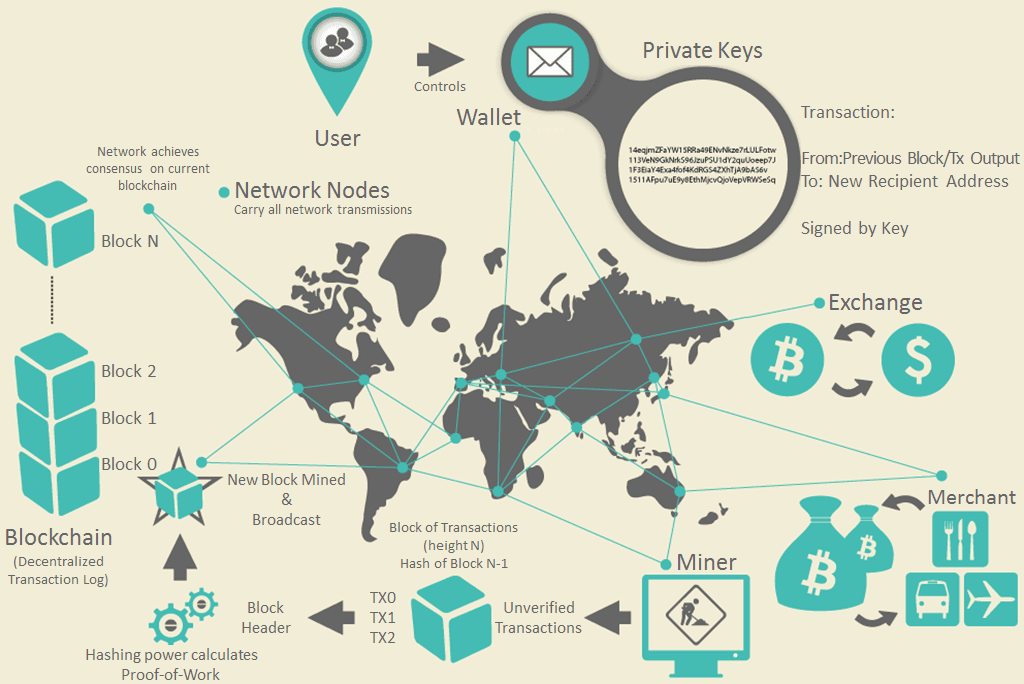
In the overview diagram shown in Bitcoin Overview, we see that the bitcoin system consists of users with wallets containing keys, transactions that are propagated across the network, and miners who produce (through competitive computation) the consensus blockchain, which is the authoritative ledger of all transactions.
Each example in this chapter is based on an actual transaction made on the bitcoin network, simulating the interactions between the users (Joe, Alice, Bob, and Gopesh) by sending funds from one wallet to another. While tracking a transaction through the bitcoin network to the blockchain, we will use a blockchain explorersite to visualize each step. A blockchain explorer is a web application that operates as a bitcoin search engine, in that it allows you to search for addresses, transactions, and blocks and see the relationships and flows between them.
Figure 1. Bitcoin overviewPopular blockchain explorers include:
BlockCypher Explorer Blockchain.com BitPay Insight Blockstream ExplorerEach of these has a search function that can take a Bitcoin address, transaction hash, block number, or block hash and retrieve corresponding information from the Bitcoin network. With each transaction or block example, we will provide a URL so you can look it up yourself and study it in detail.
Buying a Cup of Coffee
Alice, introduced in the previous chapter, is a new user who has just acquired her first bitcoin. In [getting_first_bitcoin], Alice met with her friend Joe to exchange some cash for bitcoin. The transaction created by Joe funded Alice’s wallet with 0.10 BTC. Now Alice will make her first retail transaction, buying a cup of coffee at Bob’s coffee shop in Palo Alto, California.
Bob’s Cafe recently started accepting bitcoin payments by adding a bitcoin option to its point-of-sale system. The prices at Bob’s Cafe are listed in the local currency (US dollars), but at the register, customers have the option of paying in either dollars or bitcoin. Alice places her order for a cup of coffee and Bob enters it into the register, as he does for all transactions. The point-of-sale system automatically converts the total price from US dollars to bitcoin at the prevailing market rate and displays the price in both currencies:
Total:
$1.50 USD
0.015 BTC
Bob says, «That’s one-dollar-fifty, or fifteen millibits.»
Bob’s point-of-sale system will also automatically create a special QR code containing a payment request (see Payment request QR code).
Unlike a QR code that simply contains a destination Bitcoin address, a payment request is a QR-encoded URL that contains a destination address, a payment amount, and a generic description such as «Bob’s Cafe.» This allows a bitcoin wallet application to prefill the information used to send the payment while showing a human-readable description to the user. You can scan the QR code with a bitcoin wallet application to see what Alice would see.
Figure 2. Payment request QR codeTip
Try to scan this with your wallet to see the address and amount but DO NOT SEND MONEY.The payment request QR code encodes the following URL, defined in BIP-21:
bitcoin:1GdK9UzpHBzqzX2A9JFP3Di4weBwqgmoQA?
amount=0.015&
label=Bob%27s%20Cafe&
message=Purchase%20at%20Bob%27s%20Cafe

Components of the URL

A Bitcoin address: "1GdK9UzpHBzqzX2A9JFP3Di4weBwqgmoQA"
The payment amount: "0.015"
A label for the recipient address: "Bob's Cafe"
A description for the payment: "Purchase at Bob's Cafe"
Alice uses her smartphone to scan the barcode on display. Her smartphone shows a payment of 0.0150 BTC to Bob’s Cafe and she selects Send to authorize the payment. Within a few seconds (about the same amount of time as a credit card authorization), Bob sees the transaction on the register, completing the transaction.
In the following sections, we will examine this transaction in more detail. We’ll see how Alice’s wallet constructed it, how it was propagated across the network, how it was verified, and finally, how Bob can spend that amount in subsequent transactions.
Note
The Bitcoin network can transact in fractional values, e.g., from millibitcoin (1/1000th of a bitcoin) down to 1/100,000,000th of a bitcoin, which is known as a satoshi. Throughout this book, we’ll use the term “bitcoin” to refer to any quantity of bitcoin currency, from the smallest unit (1 satoshi) to the total number (21,000,000) of all bitcoin that will ever be mined.You can examine Alice’s transaction to Bob’s Cafe on the blockchain using a block explorer site (View Alice’s transaction on blockchain.com):
Example 1. View Alice’s transaction on blockchain.com
https://www.blockchain.com/btc/tx/0627052b6f28912f2703066a912ea577f2ce4da4caa5a5fbd8a57286c345c2f2
Bitcoin Transactions
In simple terms, a transaction tells the network that the owner of some bitcoin value has authorized the transfer of that value to another owner. The new owner can now spend the bitcoin by creating another transaction that authorizes the transfer to another owner, and so on, in a chain of ownership.
Transaction Inputs and Outputs
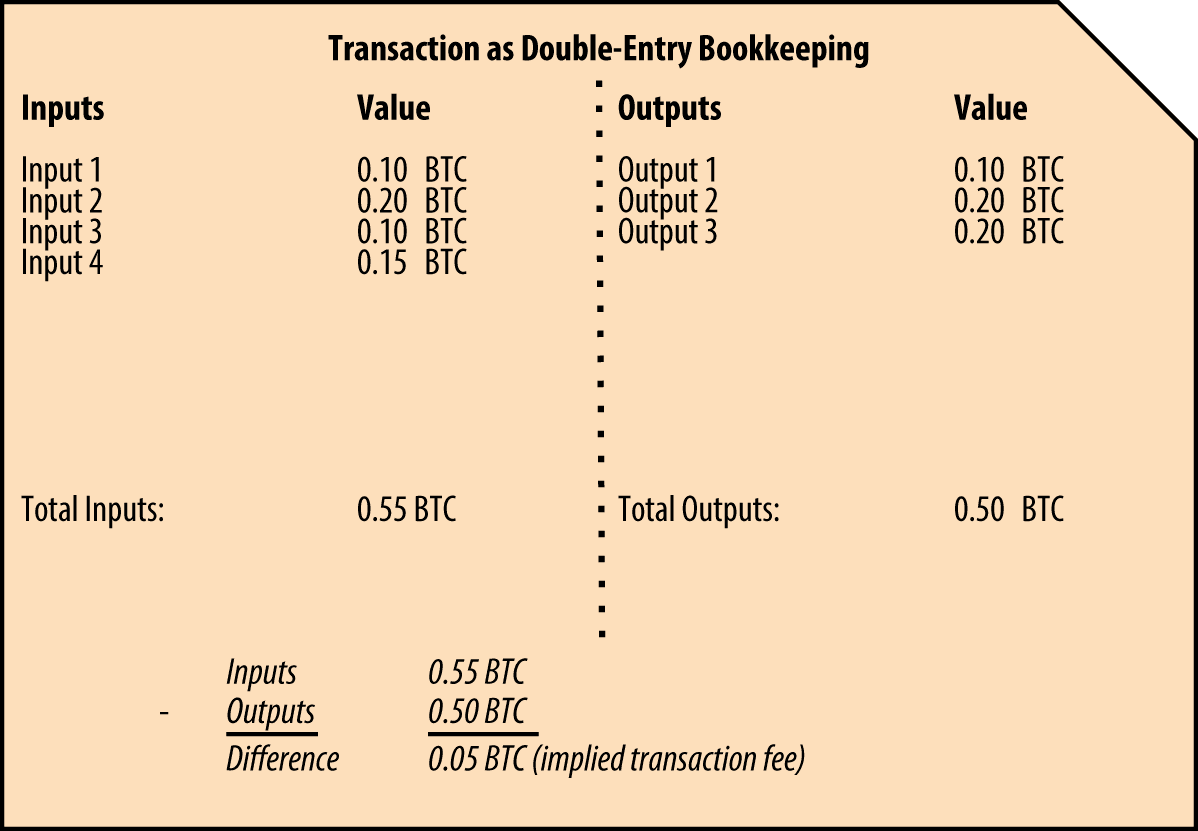
Transactions are like lines in a double-entry bookkeeping ledger. Each transaction contains one or more «inputs,» which are like debits against a bitcoin account. On the other side of the transaction, there are one or more «outputs,» which are like credits added to a bitcoin account. The inputs and outputs (debits and credits) do not necessarily add up to the same amount. Instead, outputs add up to slightly less than inputs and the difference represents an implied transaction fee, which is a small payment collected by the miner who includes the transaction in the ledger. A bitcoin transaction is shown as a bookkeeping ledger entry in Transaction as double-entry bookkeeping.
The transaction also contains proof of ownership for each amount of bitcoin (inputs) whose value is being spent, in the form of a digital signature from the owner, which can be independently validated by anyone. In bitcoin terms, «spending» is signing a transaction that transfers value from a previous transaction over to a new owner identified by a Bitcoin address.
Figure 3. Transaction as double-entry bookkeepingTransaction Chains
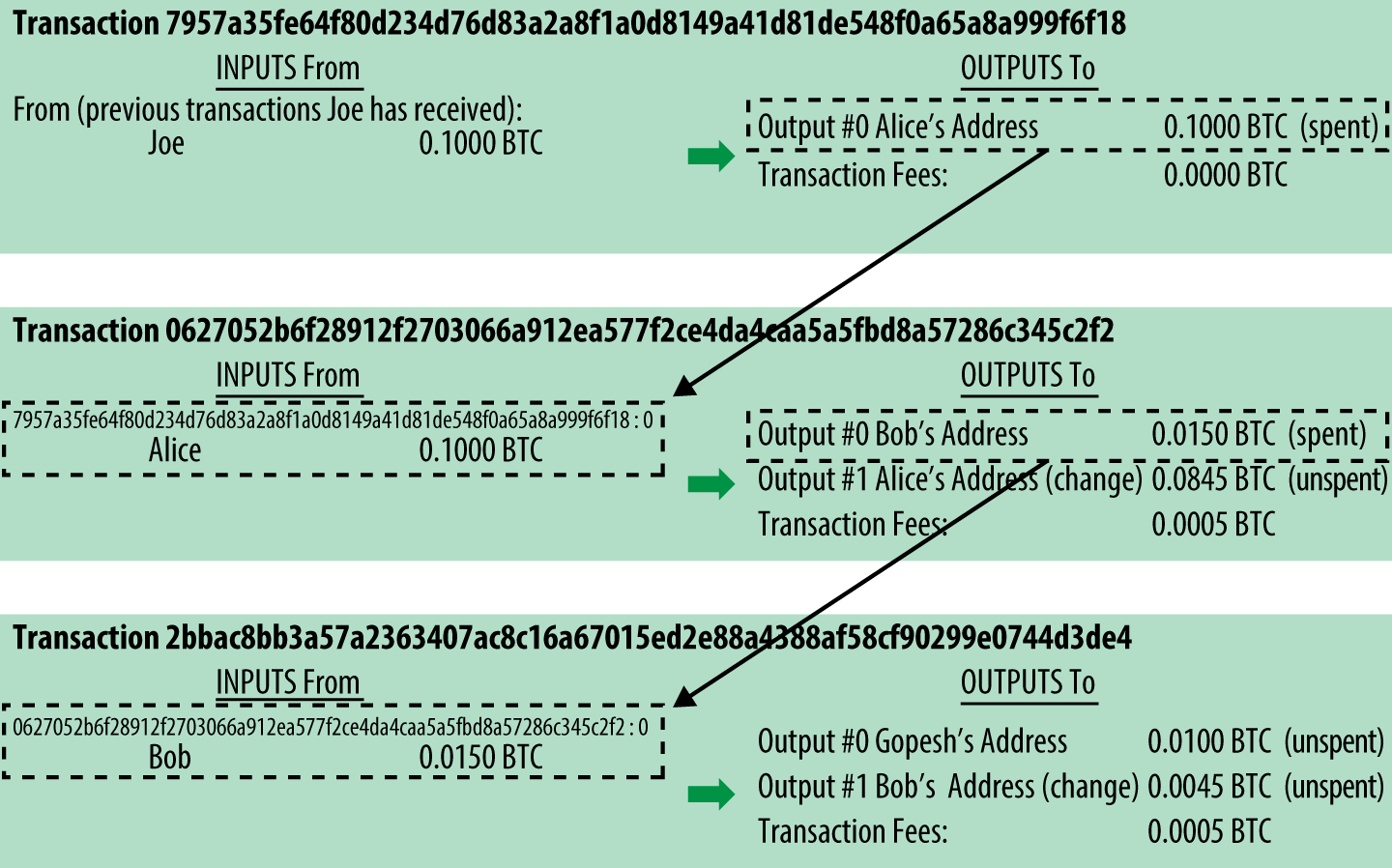
Alice’s payment to Bob’s Cafe uses a previous transaction’s output as its input. In the previous chapter, Alice received bitcoin from her friend Joe in return for cash. That transaction created a bitcoin value locked by Alice’s key. Her new transaction to Bob’s Cafe references the previous transaction as an input and creates new outputs to pay for the cup of coffee and receive change. The transactions form a chain, where the inputs from the latest transaction correspond to outputs from previous transactions. Alice’s key provides the signature that unlocks those previous transaction outputs, thereby proving to the Bitcoin network that she owns the funds. She attaches the payment for coffee to Bob’s address, thereby «encumbering» that output with the requirement that Bob produces a signature in order to spend that amount. This represents a transfer of value between Alice and Bob. This chain of transactions, from Joe to Alice to Bob, is illustrated in A chain of transactions, where the output of one transaction is the input of the next transaction.
Figure 4. A chain of transactions, where the output of one transaction is the input of the next transactionMaking Change
Many bitcoin transactions will include outputs that reference both an address of the new owner and an address of the current owner, called the change address. This is because transaction inputs, like currency notes, cannot be divided. If you purchase a $5 US dollar item in a store but use a $20 US dollar bill to pay for the item, you expect to receive $15 US dollars in change. The same concept applies to bitcoin transaction inputs. If you purchased an item that costs 5 bitcoin but only had a 20 bitcoin input to use, your wallet would create a single transaction that sends two outputs, one output of 5 bitcoin to the store owner and one output of 15 bitcoin back to yourself as change (less any applicable transaction fee). Importantly, the change address does not have to be the same address as that of the input and for privacy reasons is often a new address from the owner’s wallet.
Different wallets may use different strategies when aggregating inputs to make a payment requested by the user. They might aggregate many small inputs, or use one that is equal to or larger than the desired payment. Unless the wallet can aggregate inputs in such a way to exactly match the desired payment plus transaction fees, the wallet will need to generate some change. This is very similar to how people handle cash. If you always use the largest bill in your pocket, you will end up with a pocket full of loose change. If you only use the loose change, you’ll always have only big bills. People subconsciously find a balance between these two extremes, and bitcoin wallet developers strive to program this balance.
In summary, transactions move value from transaction inputs to transaction outputs. An input is a reference to a previous transaction’s output, showing where the value is coming from. A transaction usually includes an output that directs a specific value to a new owner’s Bitcoin address and a change output back to the original owner. Outputs from one transaction can be used as inputs in a new transaction, thus creating a chain of ownership as the value is moved from owner to owner (see A chain of transactions, where the output of one transaction is the input of the next transaction).
Common Transaction Forms
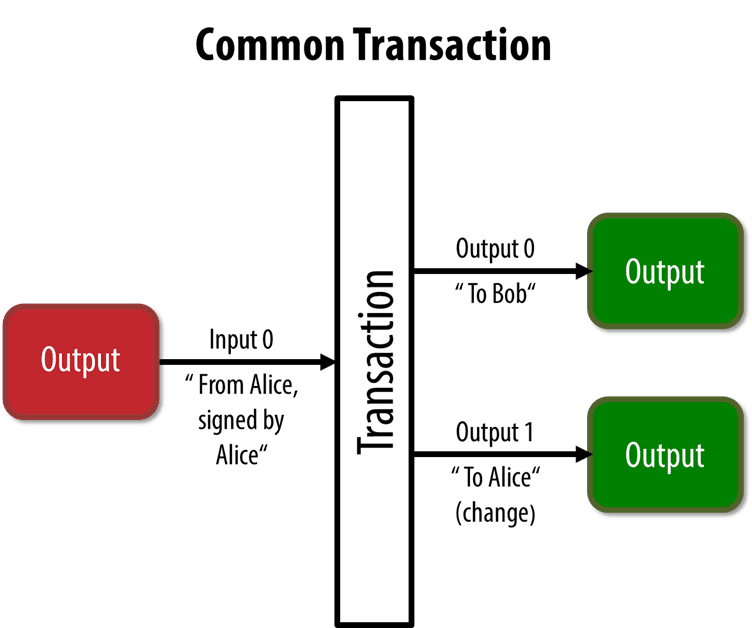
The most common form of transaction is a simple payment from one address to another, which often includes some «change» returned to the original owner. This type of transaction has one input and two outputs and is shown in Most common transaction.
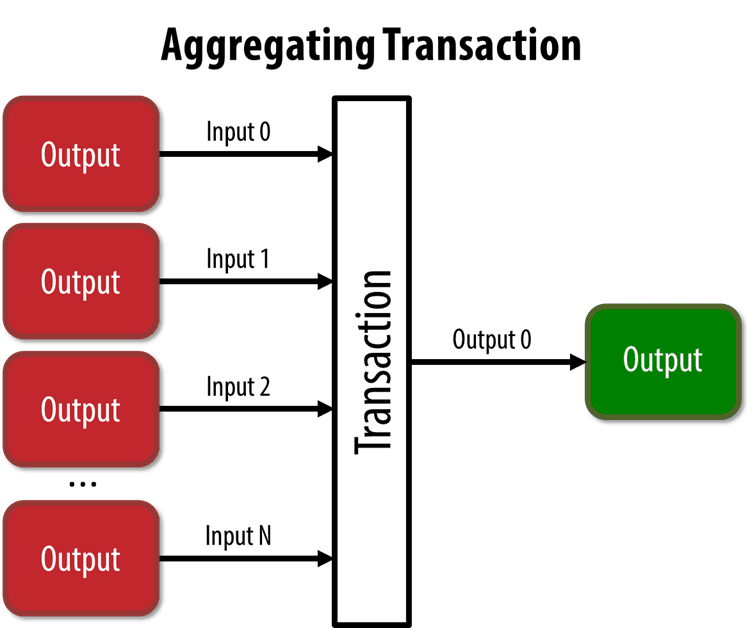
Figure 5. Most common transactionAnother common form of transaction is one that aggregates several inputs into a single output (see Transaction aggregating funds). This represents the real-world equivalent of exchanging a pile of coins and currency notes for a single larger note. Transactions like these are sometimes generated by wallet applications to clean up lots of smaller amounts that were received as change for payments.
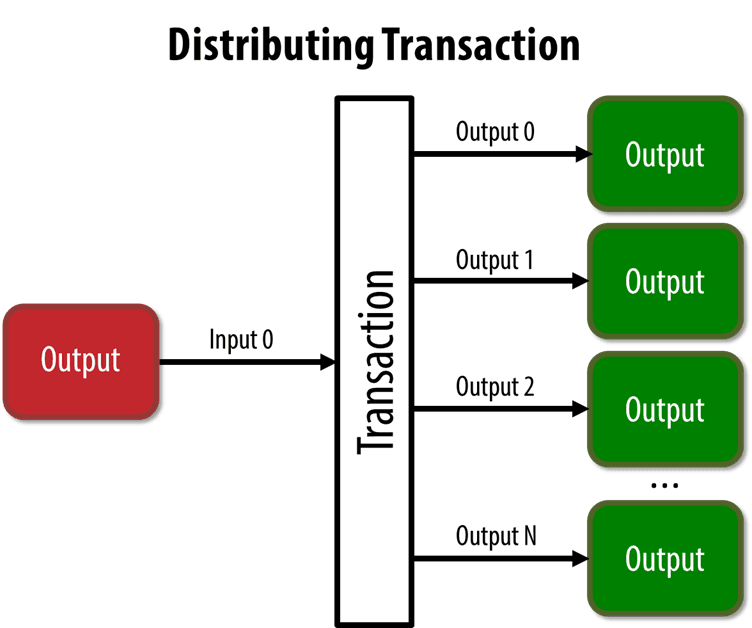
Figure 6. Transaction aggregating fundsFinally, another transaction form that is seen often on the bitcoin ledger is a batched transaction, which distributes one input to multiple outputs representing multiple recipients, a technique called «transaction batching» (see Transaction distributing funds). Since this type of transaction is useful for saving in transaction fees, it is commonly used by commercial entities to distribute funds, such as when a company is processing payroll payments to multiple employees or when a bitcoin exchange is processing multiple customers‘ withdrawals in a single transaction.
Figure 7. Transaction distributing fundsConstructing a Transaction
Alice’s wallet application contains all the logic for selecting appropriate inputs and outputs to build a transaction to Alice’s specification. Alice only needs to specify a destination and an amount, and the rest happens in the wallet application without her seeing the details. Importantly, a wallet application can construct transactions even if it is completely offline. Like writing a check at home and later sending it to the bank in an envelope, the transaction does not need to be constructed and signed while connected to the Bitcoin network.
Getting the Right Inputs
Alice’s wallet application will first have to find inputs that can pay the amount she wants to send to Bob. Most wallets keep track of all the available outputs belonging to addresses in the wallet. Therefore, Alice’s wallet would contain a copy of the transaction output from Joe’s transaction, which was created in exchange for cash (see [getting_first_bitcoin]). A bitcoin wallet application that runs as a full-node client actually contains a copy of every unspent output from every transaction in the blockchain. This allows a wallet to construct transaction inputs as well as quickly verify incoming transactions as having correct inputs. However, because a full-node client takes up a lot of disk space, most user wallets run «lightweight» clients that track only the user’s own unspent outputs.
If the wallet application does not maintain a copy of unspent transaction outputs, it can query the Bitcoin network to retrieve this information using a variety of APIs available by different providers or by asking a full-node using an application programming interface (API) call. Look up all the unspent outputs for Alice’s Bitcoin address shows an API request, constructed as an HTTP GET command to a specific URL. This URL will return all the unspent transaction outputs for an address, giving any application the information it needs to construct transaction inputs for spending. We use the simple command-line HTTP client cURL to retrieve the response.
Example 2. Look up all the unspent outputs for Alice’s Bitcoin address
$ curl https://blockchain.info/unspent?active=1Cdid9KFAaatwczBwBttQcwXYCpvK8h7FK
{

	"unspent_outputs":[

		{
			"tx_hash":"186f9f998a5...2836dd734d2804fe65fa35779",
			"tx_index":104810202,
			"tx_output_n": 0,
			"script":"76a9147f9b1a7fb68d60c536c2fd8aeaa53a8f3cc025a888ac",
			"value": 10000000,
			"value_hex": "00989680",
			"confirmations":0
		}

	]
}
The response in Look up all the unspent outputs for Alice’s Bitcoin address shows one unspent output (one that has not been redeemed yet) under the ownership of Alice’s address 1Cdid9KFAaatwczBwBttQcwXYCpvK8h7FK. The response includes the reference to the transaction in which this unspent output is contained (the payment from Joe) and its value in satoshis, at 10 million, equivalent to 0.10 bitcoin. With this information, Alice’s wallet application can construct a transaction to transfer that value to new owner addresses.
Tip
View the transaction from Joe to Alice.As you can see, Alice’s wallet contains enough bitcoin in a single unspent output to pay for the cup of coffee. Had this not been the case, Alice’s wallet application might have to «rummage» through a pile of smaller unspent outputs, like picking coins from a purse until it could find enough to pay for the coffee. In both cases, there might be a need to get some change back, which we will see in the next section, as the wallet application creates the transaction outputs (payments).
Creating the Outputs
A transaction output is created in the form of a script that creates an encumbrance on the value and can only be redeemed by the introduction of a solution to the script. In simpler terms, Alice’s transaction output will contain a script that says something like, «This output is payable to whoever can present a signature from the key corresponding to Bob’s address.» Because only Bob has the wallet with the keys corresponding to that address, only Bob’s wallet can present such a signature to redeem this output. Alice will therefore «encumber» the output value with a demand for a signature from Bob.
This transaction will also include a second output, because Alice’s funds are in the form of a 0.10 BTC output, too much money for the 0.015 BTC cup of coffee. Alice will need 0.085 BTC in change. Alice’s change payment is created by Alice’s wallet as an output in the very same transaction as the payment to Bob. Essentially, Alice’s wallet breaks her funds into two payments: one to Bob and one back to herself. She can then use (spend) the change output in a subsequent transaction.
Finally, for the transaction to be processed by the network in a timely fashion, Alice’s wallet application will add a small fee. This is not explicit in the transaction; it is implied by the difference between inputs and outputs. If instead of taking 0.085 in change, Alice creates only 0.0845 as the second output, there will be 0.0005 BTC (half a millibitcoin) left over. The input’s 0.10 BTC is not fully spent with the two outputs, because they will add up to less than 0.10. The resulting difference is the transaction fee t
Thu, 19 Jan 2023 - 37min - 16 - Introduction to Bitcoin
This episode of the Openstream Podcast contains the first chapter of Mastering Bitcoin as an «audio book», created with Google Cloud Text-to-Speech, which can convert text into natural-sounding speech using an API powered by Google’s AI (artificial intelligence) technologies. But don’t worry, it’s not gonna sound like your typical computer voice!
The text is derived from the book’s Github repository develop branch, which means that it contains various improvements from after the second edition’s release in 2017. The book is directed towards developers, but the first two chapters «Introduction» and «How Bitcoin Works» are very interesting and very well digestible for non-developers, too. The second chapter will be part of the next podcast episode.
Unfortunately, the book does not seem to be available in German yet. The second edition is also available in Spanish and Romanian. The first edition in Chinese, Brazilian Portuguese, Japanese, Greek, Czech and Hungarian. You can either listen to the first chapter above or read it after the following small anecdote:
Bitcoin Meetup Switzerland
In October 2016 Openstream founder Nick Weisser attended a meetup at Glockenhof Zürich about freedom of speech and finances by author and keynote speaker Andreas M. Antonopoulos, organized by the Bitcoin Association Switzerland. Bitcoin Meetup Switzerland often had been attracting around 50-100 attendees, but this evening in 2016 was different. Around 300 Bitcoin enthusiasts came to listen to one of the most knowledgable speakers on the topic of Bitcoin and blockchain.
At the beginning of his captivating talk, Andreas announced a new book he was going to write together with Ethereum co-founder Gavin Wood: Mastering Ethereum.
Open embedded content from YouTube Bitcoin Meetup Switzerland October 2016Back in 2014, Andreas published the first edition of Mastering Bitcoin, a book for developers. The first two chapters cover bitcoin at a level that is also approachable to non-programmers. Anyone with a basic understanding of technology can read the first two chapters to understand how bitcoin works.
Both Mastering Ethereum and the now second edition of Mastering Bitcoin are available for free on Github under a Creative Commons license or as a hard copy from O’Reilly Media. The hard copies can be purchased directly from Andreas‘ website in fiat or crypto currency.
Credits
Ant picture by Wolfgang Hasselmann Intro Music by Northern Dusk Outro from fireside chat with Michael Saylor and Max Keiser at Bitcoin Conference 2021 in Miami Mastering Bitcoin – Second Edition by Andreas M. Antonopoulos is licensed under a Creative Commons Attribution-ShareAlike 4.0 International License.So here’s the first chapter and introduction of the book respectively:
Chapter 1: What Is Bitcoin?
Bitcoin is a collection of concepts and technologies that form the basis of a digital money ecosystem. Units of currency called bitcoin are used to store and transmit value among participants in the bitcoin network. Bitcoin users communicate with each other using the bitcoin protocol primarily via the internet, although other transport networks can also be used. The bitcoin protocol stack, available as open source software, can be run on a wide range of computing devices, including laptops and smartphones, making the technology easily accessible.
Users can transfer bitcoin over the network to do just about anything that can be done with conventional currencies, including buying and selling goods, sending money to people or organizations, or extending credit. Bitcoin can be purchased, sold, and exchanged for other currencies at specialized currency exchanges. Bitcoin in a sense is the perfect form of money for the internet because it is fast, secure, and borderless.
Unlike traditional currencies, bitcoin is entirely virtual. There are no physical coins or even digital coins per se. The coins are implied in transactions that transfer value from sender to recipient. Users of bitcoin own keys that allow them to prove ownership of bitcoin in the bitcoin network. With these keys, they can sign transactions to unlock the value and spend it by transferring it to a new owner. Keys are often stored in a digital wallet on each user’s computer or smartphone. Possession of the key that can sign a transaction is the only prerequisite to spending bitcoin, putting the control entirely in the hands of each user.
Bitcoin is a distributed, peer-to-peer system. As such, there is no «central» server or point of control. Bitcoins,i.e. units of bitcoin, are created through a process called «mining,» which involves competing to find solutions to a mathematical problem while processing bitcoin transactions. Any participant in the bitcoin network (i.e., anyone using a device running the full bitcoin protocol stack) may operate as a miner, using their computer’s processing power to verify and record transactions. Every 10 minutes, on average, a bitcoin miner can validate the transactions of the past 10 minutes and is rewarded with brand new bitcoin. Essentially, bitcoin mining decentralizes the currency-issuance and clearing functions of a central bank and replaces the need for any central bank.
The bitcoin protocol includes built-in algorithms that regulate the mining function across the network. The difficulty of the processing task that miners must perform is adjusted dynamically so that, on average, someone succeeds every 10 minutes regardless of how many miners (and how much processing) are competing at any moment. The protocol also halves the rate at which new bitcoin is created every 4 years, and limits the total number of bitcoin that will be created to a fixed total just below 21 million coins. The result is that the number of bitcoin in circulation closely follows an easily predictable curve that approaches 21 million by the year 2140. Due to bitcoin’s diminishing rate of issuance, over the long term, the bitcoin currency is deflationary. Furthermore, bitcoin cannot be inflated by «printing» new money above and beyond the expected issuance rate.
Behind the scenes, bitcoin is also the name of the protocol, a peer-to-peer network, and a distributed computing innovation. The bitcoin currency is really only the first application of this invention. Bitcoin represents the culmination of decades of research in cryptography and distributed systems and includes four key innovations brought together in a unique and powerful combination. Bitcoin consists of:
A decentralized peer-to-peer network (the bitcoin protocol) A public transaction ledger (the blockchain) A set of rules for independent transaction validation and currency issuance (consensus rules) A mechanism for reaching global decentralized consensus on the valid blockchain (Proof-of-Work algorithm)As a developer, I see bitcoin as akin to the internet of money, a network for propagating value and securing the ownership of digital assets via distributed computation. There’s a lot more to bitcoin than first meets the eye.
In this chapter we’ll get started by explaining some of the main concepts and terms, getting the necessary software, and using bitcoin for simple transactions. In the following chapters, we’ll start unwrapping the layers of technology that make bitcoin possible and examine the inner workings of the bitcoin network and protocol.
Digital Currencies Before Bitcoin
The emergence of viable digital money is closely linked to developments in cryptography. This is not surprising when one considers the fundamental challenges involved with using bits to represent value that can be exchanged for goods and services. Three basic questions for anyone accepting digital money are:
- Can I trust that the money is authentic and not counterfeit? Can I trust that the digital money can only be spent once (known as the “double-spend” problem)? Can I be sure that no one else can claim this money belongs to them and not me?
Issuers of paper money are constantly battling the counterfeiting problem by using increasingly sophisticated papers and printing technology. Physical money addresses the double-spend issue easily because the same paper note cannot be in two places at once. Of course, conventional money is also often stored and transmitted digitally. In these cases, the counterfeiting and double-spend issues are handled by clearing all electronic transactions through central authorities that have a global view of the currency in circulation. For digital money, which cannot take advantage of esoteric inks or holographic strips, cryptography provides the basis for trusting the legitimacy of a user’s claim to value. Specifically, cryptographic digital signatures enable a user to sign a digital asset or transaction proving the ownership of that asset. With the appropriate architecture, digital signatures also can be used to address the double-spend issue.
When cryptography started becoming more broadly available and understood in the late 1980s, many researchers began trying to use cryptography to build digital currencies. These early digital currency projects issued digital money, usually backed by a national currency or precious metal such as gold.
Although these earlier digital currencies worked, they were centralized and, as a result, were easy to attack by governments and hackers. Early digital currencies used a central clearinghouse to settle all transactions at regular intervals, just like a traditional banking system. Unfortunately, in most cases, these nascent digital currencies were targeted by worried governments and eventually litigated out of existence. Some failed in spectacular crashes when the parent company liquidated abruptly. To be robust against intervention by antagonists, whether legitimate governments or criminal elements, a decentralized digital currency was needed to avoid a single point of attack. Bitcoin is such a system, decentralized by design, and free of any central authority or point of control that can be attacked or corrupted.
History of Bitcoin
Bitcoin was invented in 2008 with the publication of a paper titled «Bitcoin: A Peer-to-Peer Electronic Cash System,» written under the alias of Satoshi Nakamoto (see bitcoin.org/bitcoin.pdf). Nakamoto combined several prior inventions such as b-money and HashCash to create a completely decentralized electronic cash system that does not rely on a central authority for currency issuance or settlement and validation of transactions. The key innovation was to use a distributed computation system (called a «Proof-of-Work» algorithm) to conduct a global «election» every 10 minutes, allowing the decentralized network to arrive at consensus about the state of transactions. This elegantly solves the issue of double-spend where a single currency unit can be spent twice. Previously, the double-spend problem was a weakness of digital currency and was addressed by clearing all transactions through a central clearinghouse.
The bitcoin network started in 2009, based on a reference implementation published by Nakamoto and since revised by many other programmers. The implementation of the Proof-of-Work algorithm (mining) that provides security and resilience for bitcoin has increased in power exponentially, and now exceeds the combined processing power of the world’s top supercomputers. Bitcoin’s total market value has at times exceeded $1 trillion US dollars, depending on the bitcoin-to-dollar exchange rate. The largest transaction processed so far by the network was $1.1 billion US dollars, transmitted instantly and processed for a fee of only $0.68.
Satoshi Nakamoto withdrew from the public in April 2011, leaving the responsibility of developing the code and network to a thriving group of volunteers. The identity of the person or people behind bitcoin is still unknown. However, neither Satoshi Nakamoto nor anyone else exerts individual control over the bitcoin system, which operates based on fully transparent mathematical principles, open source code, and consensus among participants. The invention itself is groundbreaking and has already spawned new science in the fields of distributed computing, economics, and econometrics.
A Solution to a Distributed Computing Problem
Satoshi Nakamoto’s invention is also a practical and novel solution to a problem in distributed computing, known as the «Byzantine Generals‘ Problem.» Briefly, the problem consists of trying to agree on a course of action or the state of a system by exchanging information over an unreliable and potentially compromised network. Satoshi Nakamoto’s solution, which uses the concept of Proof-of-Work to achieve consensus without a central trusted authority, represents a breakthrough in distributed computing and has wide applicability beyond currency. It can be used to achieve consensus on decentralized networks to prove the fairness of elections, lotteries, asset registries, digital notarization, and more.
Bitcoin Uses, Users, and Their Stories
Bitcoin is an innovation in the ancient technology of money. At its core, money simply facilitates the exchange of value between people. Therefore, in order to fully understand bitcoin and its uses, we’ll examine it from the perspective of people using it. Each of the people and their stories, as listed here, illustrates one or more specific use cases. We’ll be seeing them throughout the book:
North American low-value retail
Alice lives in Northern California’s Bay Area. She has heard about bitcoin from her techie friends and wants to start using it. We will follow her story as she learns about bitcoin, acquires some, and then spends some of her bitcoin to buy a cup of coffee at Bob’s Cafe in Palo Alto. This story will introduce us to the software, the exchanges, and basic transactions from the perspective of a retail consumer.
North American high-value retail
Carol is an art gallery owner in San Francisco. She sells expensive paintings for bitcoin. This story will introduce the risks of a «51%» consensus attack for retailers of high-value items.
Offshore contract services
Bob, the cafe owner in Palo Alto, is building a new website. He has contracted with an Indian web developer, Gopesh, who lives in Bangalore, India. Gopesh has agreed to be paid in bitcoin. This story will examine the use of bitcoin for outsourcing, contract services, and international wire transfers.
Web store
Gabriel is an enterprising young teenager in Rio de Janeiro, running a small web store that sells bitcoin-branded t-shirts, coffee mugs, and stickers. Gabriel is too young to have a bank account, but his parents are encouraging his entrepreneurial spirit.
Charitable donations
Eugenia is the director of a children’s charity in the Philippines. Recently she has discovered bitcoin and wants to use it to reach a whole new group of foreign and domestic donors to fundraise for her charity. She’s also investigating ways to use bitcoin to distribute funds quickly to areas of need. This story will show the use of bitcoin for global fundraising across currencies and borders and the use of an open ledger for transparency in charitable organizations.
Import/export
Mohammed is an electronics importer in Dubai. He’s trying to use bitcoin to buy electronics from the United States and China for import into the UAE to accelerate the process of payments for imports. This story will show how bitcoin can be used for large business-to-business international payments tied to physical goods.
Mining for bitcoin
Jing is a computer engineering student in Shanghai. He has built a «mining» rig to mine for bitcoin using his engineering skills to supplement his income. This story will examine the «industrial» base of bitcoin: the specialized equipment used to secure the bitcoin network and issue new currency.
Each of these stories is based on the real people and real industries currently using bitcoin to create new markets, new industries, and innovative solutions to global economic issues.
Getting Started
Bitcoin is a protocol that can be accessed using a client application that speaks the protocol. A «bitcoin wallet» is the most common user interface to the bitcoin system, just like a web browser is the most common user interface for the HTTP protocol. There are many implementations and brands of bitcoin wallets, just like there are many brands of web browsers (e.g., Chrome, Safari, Firefox, and Internet Explorer). And just like we all have our favorite browsers (Mozilla Firefox, Yay!) and our villains (Internet Explorer, Yuck!), bitcoin wallets vary in quality, performance, security, privacy, and reliability. There is also a reference implementation of the bitcoin protocol that includes a wallet, known as the «Satoshi Client» or «Bitcoin Core,» which is derived from the original implementation written by Satoshi Nakamoto.
Choosing a Bitcoin Wallet
Bitcoin wallets are one of the most actively developed applications in the bitcoin ecosystem. There is intense competition, and while a new wallet is probably being developed right now, several wallets from last year are no longer actively maintained. Many wallets focus on specific platforms or specific uses and some are more suitable for beginners while others are filled with features for advanced users. Choosing a wallet is highly subjective and depends on the use and user expertise. Therefore it would be pointless to recommend a specific brand or wallet. However, we can categorize bitcoin wallets according to their platform and function and provide some clarity about all the different types of wallets that exist. Better yet, moving keys or seeds between bitcoin wallets is relatively easy, so it is worth trying out several different wallets until you find one that fits your needs.
Bitcoin wallets can be categorized as follows, according to the platform:
Desktop wallet
A desktop wallet was the first type of bitcoin wallet created as a reference implementation and many users run desktop wallets for the features, autonomy, and control they offer. Running on general-use operating systems such as Windows and Mac OS has certain security disadvantages, however, as these platforms are often insecure and poorly configured.
Mobile wallet
A mobile wallet is the most common type of bitcoin wallet. Running on smart-phone operating systems such as Apple iOS and Android, these wallets are often a great choice for new users. Many are designed for simplicity and ease-of-use, but there are also fully featured mobile wallets for power users.
Web wallet
Web wallets are accessed through a web browser and store the user’s wallet on a server owned by a third party. This is similar to webmail in that it relies entirely on a third-party server. Some of these services operate using client-side code running in the user’s browser, which keeps control of the bitcoin keys in the hands of the user. Most, however, present a compromise by taking control of the bitcoin keys from users in exchange for ease-of-use. It is inadvisable to store large amounts of bitcoin on third-party systems.
Hardware wallet
Hardware wallets are devices that operate a secure self-contained bitcoin wallet on special-purpose hardware. They are operated via USB with a desktop web browser or via near-field-communication (NFC) on a mobile device. By handling all bitcoin-related operations on the specialized hardware, these wallets are considered very secure and suitable for storing large amounts of bitcoin.
Paper wallet
The keys controlling bitcoin can also be printed for long-term storage. These are known as paper wallets even though other materials (wood, metal, etc.) can be used. Paper wallets offer a low-tech but highly secure means of storing bitcoin long term. Offline storage is also often referred to as cold storage.
Anoth
Sun, 13 Jun 2021 - 34min - 15 - Die neuen Bewertungskriterien von Google
Ab Mai 2021 wird Google bei der Bewertung von Webseiten drei Faktoren in erheblicher Weise berücksichtigen:
Cumulative Layout Shift (CLS)Largest Contentful Paint (LCP)First Input Delay (FID)EntwicklerInnen und AutorenInnen, die sich mit diesen Werten nicht beschäftigen, laufen Gefahr, dass ihre Seiten an Ranking verlieren. In dieser Präsentation am WordPress Meetup Berlin Ende Januar 2021 gibt WordPress Developer und Podcaster Phil Marx einen Einstieg in die Bedeutung dieser Begriffe, wie man seine eigene Seite prüfen kann und einige grundsätzliche Verbesserungsvorschläge.
Die Fragen und Antworten am Ende der Präsentation sind nicht in diesem Podcast enthalten, sind aber in den Show Notes verlinkt. Ebenso die Slides.
Zielgruppe: SEO, Entwickler, Fortgeschrittene
Bild: Phil MarxLinks
Slides der PräsentationVideo Präsentation auf WordPress.TV (inkl. Fragen & Antworten)Nerdtalk Podcast und Webfalken von Phil MarxCredits
Musik von Northern DuskBilder von Phil Marx und Rajeshwar BachuTranskript
Vielen lieben Dank, dass ihr alle so zahlreich da seid. Ich hätte echt nicht mit so vielen Besuchern gerechnet und vor allem nicht mit so vielen InteressentInnen. Freut mich total, dass ihr jetzt hier so in dieser grossen Masse teilnehmt. Maja hat es gerade eben schon gesagt: Das ist ein etwas kerniger Vortrag. Jedoch gar nicht mal von der Komplexität, also ich glaube nicht, dass das jetzt total kompliziert wird und nur Programmierer oder SEO Experten das hier verstehen werden. Aber bei bestimmten Dingen brauche ich einfach eure Konzentration, weil die Bewertungskriterien von Google sind in Zukunft, zumindest die, die jetzt im Mai 2021 kommen werden, gar nicht mal so leicht verständlich sondern es ist ein bisschen technischer und schon fast ein bisschen mathematisch. Schauen wir einfach mal gemeinsam darauf. Erst mal ein paar Worte zu mir. Ich bin Phil Marx. Ich bin gelernter Fachinformatiker, arbeite schon seit 2009 mit WordPress, habe dort meinen eigens selbst geschriebenen Blog mal irgendwann auf WordPress überführt und seit 2018 betreue ich nun Kundenwebseiten und unterstütze sie in allem, was sie dort so benötigen.
Was haben wir heute vor? Damit einfach alle ein bisschen abgeholt sind – Ich kenne ja euren Level nicht oder wie weit ihr jetzt schon in Sachen SEO up to date oder mit der Technik seid. Deshalb gibt es einen ganz kurzen Überblick über die Geschichte von Google. Keine Sorge, wir fangen nicht in der Garage von Larry Page an. Aber ein paar wichtige Infos, warum wir überhaupt hier so gemeinsam sitzen. Zudem gibt es noch ein paar wichtige Grundlagen und dann steigen wir auch gleich in das Thema dieses Vortrages ein, nämlich die sogenannten Core Web Vitals, bestehend aus Cumulative Layout Schift, Largest Contentful Paint und First Input Delay. Das war dann so ein bisschen die Theorie und dann bekommt ihr auch noch was an die Hand, wie ihr diese Core Web Vitals selber identifizieren und ermitteln könnt.
Und am Ende nochmal so ein paar generelle Tipps, wie man im Grunde dort zum Beispiel die Werte verbessern kann. Also nochmal so eine kleine Geschichte über Google und Google verfolgt ja im Grunde schon seit vielen Jahren den Fokus auf User Experience. Ich meine, wir sind mal gestartet, da hat Google einfach nur Keywords aufgenommen, hat diese indiziert und hat dann auf Basis diesen Keywords irgendwie versucht, ein möglichst gutes Suchergebnis zu liefern. Aber bereits um 2011 begann Google damit, die User Experience mehr in den Vordergrund zu stellen.
Also dem Benutzer immer mehr, immer bessere Suchergebnisse für den Suchbegriff zu liefern und nicht nur einfach mechanisch Seiten zu indizieren und dann irgendwie nach Keyworddichte Inhalte auszuspielen. Sondern tatsächlich verstehen, was möchte der Besucher bzw. der Suchende gerade und den qualitativ höchsten verbunden mit der höchsten Zufriedenheit des Ergebnisses. Das ist ja das, was Google immer wieder verfolgt. 2011 begann Google auch Contentfarben rauszusortieren. 2013 ging es dann tatsächlich schon mit dem Verständnis von einzelnen Worten los – mit einem Hummingbird Update – damit Google schon ein bisschen in Kontext setzen konnte: «Okay, was hat der Suchende eigentlich in die Suchzeile eingegeben und was sucht er vermutlich?»
Und 2015? Da ging es auch schon los, dass Google die mobile Nutzerfreundlichkeit in den Vordergrund gestellt hat. Bei der Recherche war ich selber ein bisschen überrascht. Tatsächlich ist das jetzt schon sechs Jahre her, dass Google gesagt hat: «Okay, wir stellen jetzt die Darstellung und Usability auf Mobilgeräten in den Vordergrund anstatt der Desktop-Webseite. Und 2015 kam noch so ein bisschen KI hinzu, sodass die Suchbegriffe noch besser verstanden werden konnten. In den letzten Jahren hat das dann richtig an Dynamik gewonnen.
Gerade 2018 war es dann so, dass Google mit dem Mobile-First Indexing Update gesagt hat: «Okay, mobile Webseiten werden jetzt auch primär zum Indizieren herangezogen.» Das heisst, Google hat einen deutlich grösseren Fokus auf Mobilgeräte aber betrachtet natürlich die Desktopgeräte auch immer wieder. Aber wir kommen nachher noch zum ??Pass. Leider?? da sieht man das ganz gut an Zahlen, dass Mobilgeräte die Geräte sind, womit heutzutage gesucht wird. Und deswegen legt Google natürlich einen grossen Wert darauf, dass die Suchergebnisse bzw. die Seiten hinter den Suchergebnissen auf Mobilgeräten möglichst optimal funktionieren. Und darauf zielt auch das sogenannte Core Web Vital Update an, welches jetzt im Mai 2021 veröffentlicht werden soll. Wir hatten es gerade eben schon imm Ausblick mal ganz grob gesehen, was diese Core Web Vitals sind. Die sperrigen Begriffe Cumulative Layout Schift, Largest Contentful Paint und First Input Delay hat Google eigentlich ganz schön zusammengefasst. Eben in den Schwerpunktthemen wie loading, Interactivity und Visual Stability.
Also der Benutzer soll ein gesteigertes, positives Benutzererlebnis erfahren, wenn er ein Suchergebnis besucht in den Bereichen: Ladezeit, Interaktivität oder auch Interaktion mit der Webseite und visuelle Stabilität. Dazu kommen noch ein paar weitere Aspekte, die sind in der Grafik auch nochmal aufgezeigt, aber tatsächlich sind die Core Web Vitals das, worauf jetzt in Zukunft besonders geachtet wird. Warum das eigentlich alles? Warum sind mobile Webseiten auf einmal total angesagt?
Ich habe hier eine kleine Grafik von Statista herausgesucht: Bereits Mitte 2015 war schon ein Drittel des Webverkehrs von mobilen Geräten und jetzt bis ins dritte Quartal 2020 hinein sind wir bei 50%. Spontan würde man sagen, ist das ein sehr moderater Wert. Aber selbst wenn man diesen Wert nimmt, die Hälfte der dort erfassten Webseitenbesuche sind per Mobilgeräte passiert und Google selbst bringt Statistiken raus, die darstellen, dass allein 80 Prozent ein Smartphone benutzen und knapp 60 Prozent davon nutzen sogar zwei Geräte.
Das Spannende an der ganzen Sache ist, dass diese Grafik von 2015 ist.
Das heisst die ist schon extrem alt und die Zahl wird sich ganz bestimmt in der Folgezeit noch erhöht haben. Bevor wir das Thema mit den Core Web Vitals verstehen können, müssen wir noch zwei, drei Dinge klären, damit die Auswirkungen und Zusammenhänge der Werte verständlicher sind. Da möchte ich mit euch ganz kurz einmal in einen HTML-Quellcode hineinschauen. Das ist jetzt der etwas zusammengefasste Quellcode von der Google Webseite und die Web Entwickler und bestimmt auch die, die das schon mal ab und zu gemacht haben, wissen, dass so ein HTML-Konstrukt in drei Bereiche unterteilt werden kann. Es gibt einerseits den Header, da stehen ein paar Metadaten drinnen.
Der Titel der Webseite, aber auch Informationen zum Design und zur Interaktion der Seite. Dann gibt es den Body. Da ist in der Regel der Inhalt drinnen. Alles was wir sehen an Text und Bildern und ähnliches ist grösstenteils im Body angesiedelt. Und dann gibt es den Footer. Ich habe gerade eben schon gesagt, im Header sind z.B. Referenzen drinnen. Wir haben jetzt hier hervorgehoben, zum Beispiel eine JavaScript Datei. Hier wird also von einer externen Adresse eine JavaScript Datei eingebunden. JavaScript ist ja eine Skriptsprache, womit man Interaktionen oder auch Dynamik auf eine Website bringen kann. Das bedeutet ja, dass Dinge sich automatisch verschieben oder auf Mausklick irgendwas aufklappt oder Slider, die sind ja auch so ein typischer Fall im JavaScript Bereich. Hier im Header sind auch noch ein paar Style Angaben, also CSS Angaben. CSS Dateien sind ja dafür da, dass das Design einer Webseite sehr vereinfacht auszudrücken. Farben, Strukturen, Ausrichtungen von Überschriften, Texten, Bildern, aber auch Containern, wo man dann wiederum Inhalte reinpacken kann.
Die Definition der Grösse dieser Container, die Anordnung dieser Container all das macht man mit CSS Dateien und wir sehen im Footer entsprechend auch noch ein paar JavaScript Dateien. Warum tut man so etwas? Warum packt man JavaScript Dateien und CSS Dateien in den Kopf, aber kann sie offensichtlich auch in den Footer packen. Wenn nämlich ein Web-Browser diesen HTML Quellcode interpretieren möchte, um dann am Ende eine Webseite anzuzeigen, muss er das in der Regel von oben nach unten tätigen.
Das heisst, er liest diesen gesamten Quelltext ein und fängt dann an, auch eingebundene Script Dateien und auch die CSS Dateien abzuarbeiten und zu interpretieren und dann den Code – der da drinnen festgehalten ist – auszuführen oder in irgendeiner Form mit der Webseite zu interagieren. Die Skripte, die im Header eingebunden sind, die werden natürlich sehr schnell und sehr früh gelesen, ausgeführt und interpretiert. Und alles was im Footer unten ist, wird erst sehr verspätet ausgeführt, währenddessen schon der gesamte Body und damit der gesamte Inhalt eigentlich angezeigt ist und auch die wichtigsten CSS Dateien bereits aus dem Header gelesen und auch interpretiert wurden.
Das heisst, es besteht durchaus eine Abfolge. Die Daten im Header werden zuerst mit einer gewissen Priorität abgehandelt, währenddessen im Footer die Dateien, die dort eingebunden sind, verspätet ausgeführt werden, nämlich wenn schon andere Aktionen vorher erfolgt sind. Das ist alles technisch jetzt sehr vereinfacht ausgedrückt, aber es ist ganz wichtig zu verstehen: Es gibt zwei verschiedene Ausführungsbereiche, denn das wird nachher nochmal bei der Bewertung der Core Web Vitals ganz wichtig. Dann möchte ich ganz kurz den Begriff «Viewport» mitgeben.
Wir werden jetzt hier in diesem Vortrag zwei oder dreimal über den sogenannten Viewport sprechen, mit einem Viewport ist einfach der sichtbare Bereich in einem Mobilgerät gemeint. Das heißt eigentlich, dass wenn ihr eine Webseite aufruft und den Inhalt seht, der den gesamten Screen in Anspurch nimmt, das ist der Viewport. Einfach im Hinterkopf behalten, wird aber gleich nochmal interessant werden. Und wir sollten auch im Hinterkopf behalten: «Wie bewertet Google eigentlich mobile Webseiten, wie kriegt der Google Bot eigentlich heraus, wie eine Webseite auf einem mobilen Gerät performt?» Da schweigt natürlich Google mit welcher Engine sie da herangehen bzw. mit welcher Logik sie da herangehen.
Es häufen sich die Vermutungen, dass es aktuell die Engine eines Motorola Moto G4 ist, mit langsamer Netzanbindung. Bis vor kurzem war es noch ein Nexus 5, das war ja ein Gerät von Google. Und jetzt kam vor kurzem auch in den Entwicklertools von Google die Engine des Moto G4 mit hinein und deswegen gibt es sehr gute Vermutungen, dass dieses G4 involviert ist. Selbst wenn es das nicht ist, ist es gar nicht mal so schlecht, dass als Orientierung zu nehmen. Denn es ist ein Mobiltelefon mit einem beachtlichen Alter.
Es ist knapp fünf Jahre alt und hat eine recht geringe Displaygrösse. Das heisst, wenn wir das im Hinterkopf behalten, unsere Seiten auf eine gute Ansicht und auf gute Core Web Vitals für ein Motorola Moto G4 optimieren, dann haben wir die Seite wahrscheinlich schon generell ganz gut optimiert. Je besser das Display, je schneller die CPU, umso besser natürlich auch die Anzeige. Aber wenn wir schon auf geringerer Hardware bzw. geringerem Gerät gut emulieren können und die Seite gut aussieht, dann wird das bei besserer Hardware natürlich umso besser funktionieren.
Soviel also zur Theorie. Kommen wir zum ersten Core Web Vital, nämlich der Cumulative Layout Shift. Ich hab es mal versucht, es zu übersetzen, nämlich zusammengerechnete Layout Verschiebung. Das ist etwas krudes Deutsch, aber trifft es eigentlich ganz gut. Der Cumulative Layout Schift schreibt nämlich die Verschiebung von Inhalten nach dem initialen Design. Das heisst, wenn die Webseite einmal geladen ist und dann sich auf einmal Inhalte doch nochmal verschieben. Warum eigentlich?
Zum Beispiel weil Inhalte dynamisch nachgeladen werden, wie durch JavaScript oder ähnliches. Oder vielleicht irgendwie Widgets nochmal resizen, weil sie irgendwie in der falschen Größe definiert wurden und dann irgendwie festgestellt wird: «Ach Gott, ich werde ja auf ein Mobildisplay angezeigt und dann restrukturiert sich die gesamte Seite nochmal neu.
Oder was natürlich auch sein kann, dass grössere Bilder wie Headerbilder noch nachgeladen werden. Zum Beispiel habe ich hier eine etwas grössere Dateigrösse und Sie haben vielleicht in ihrer Deklaration in der HTML Definition keine Größenangaben mitbekommen und somit lädt auf einmal dieses Headerbild nach und drückt den Inhalt nach unten. Das sind typische Cumulative Layout Shifts. Ich habe eine kleine Demo mitgebracht. Ich bin ganz gespannt, da Videos ja immer so eine Sache in Powerpoint sind aber ich glaube es funktioniert hervorragend. Nehmen wir ein Beispiel:
Hier ist eine Order Conformation und da habt ihr es schon gesehen. Wir können gleich nochmal zurückloopen und das nochmal machen. Es ist also eine Bestellbestätigung gewesen und auf einmal ist ein Inhalt aufgetaucht. Der Benutzer klickt eigentlich auf «No go back», er will das also gar nicht bestellen, aber auf einmal hier oben, was nachgerückt ist, hat sich alles nach unten verschoben und er klickt versehentlich auf Submit-Order und generiert so eine versehentliche Bestellung. Das ist natürlich jetzt das Extrembeispiel an der Stelle, aber es zeigt halt sehr gut auf, was dieser Cumulative Layout Shift ist, nämlich, dass sich Inhalte verschieben und sich dadurch die User Experience verändern kann.
Ich hatte gerade eben schon gesagt, es ist eine Summe von Layout Shift und von gewissen Metriken und Cumulative suggeriert es ja auch schon -eine kumulative-, also etwas zusammengefasst und somit gibt es hier tatsächlich ein bisschen Mathematik. Ja, keine Sorge, es ist nicht so vertiefend und letztlich, ich habe ja diese Metriken nicht erfunden, sondern Google hat die erfunden, also müssen wir alle hier gemeinsam durch. Wird aber nicht so schlimm. Die Berechnungsgrundlage für so ein Cumulative Layout Shift und überhaupt für ein Layout Shift ist:»Um wieviel Prozent nimmt dieses bewegte Element im Viewport ein?» Wir werden das nochmal sehen und dann wird das ein kleines Stück praktischer.
Das ist dann die sogenannte Impact Fraction und dann stellt sich natürlich auch die Frage um wieviel Prozent verschiebt sich denn dieses Element? Wenn das z.B. irgendwie ein kleiner Satz ist, dann ist womöglich die Impact Fraction relativ klein, da es nur sehr schmal auf dem Screen ist. Es besteht einen Unterschied, wenn es ein grosser Absatz ist. Und natürlich ist es auch ein Unterschied, ob dieser Inhalt irgendwie ein paar Pixel verrutscht oder sogar um die Hälfte des Viewports. Diese Werte werden dann pro Element -was sich irgendwie verschiebt, springt oder was auch immer- multipliziert und dann einfach für jedes einzelne Element aufaddiert. Auch hier hab ich ein kleines Beispiel mitgebracht bzw. Google hat auch ein schönes vorbereitet.
Wir sehen hier zwei Demo-Viewports und wir sehen auf der linken Seite einen Demo-Text der 50% des Viewports einnimmt und der wird nach unten verschoben. Nach dem Verschieben von Ursprungslage bis zur Endlage haben sich 75% des Screens auf einmal verändert. Irgendwas hat sich da eben in der Ansicht verändert. Das ergibt also eine Impact Fraction von 0.75. Dieser Inhalt, der wurde um 25 Prozent verschoben und das gibt dann eine Distance Fraction von 0.25. Ich hatte ja erwähnt, dass es multipliziert wird und dadurch bekommt man ein Layout Shift für dieses einzelne Element. Das heisst, wenn wir hier ein bisschen Mathematik anwenden, kommen wir auf 0.18. Das ist jetzt der Layout Shift sozusagen für dieses Element. Merkt euch die 0.18, das wird jetzt gleich in der nächsten Folie nochmal ganz interessant. Wir haben hier also einen Inhalt, 50% wird nach unten verschoben und das ergibt Layout Shift von 018 fast 0.19. Layout Schifts werden aufgrund von User Interaktionen nicht berücksichtigt. Das heisst, wenn jemand auf den Button klickt und dann verschiebt sich was oder so, dann ist das ja was legitimes, dann ist das etwas, was auch gewollt ist. Die werden dann nicht in der Summe berücksichtigt.
Ein kleiner Unterschied an der Stelle: Natürlich kann man nicht unendlich Verzögerung annehmen. Google nimmt als Basiswert 500 Millisekunden, d.h. man klickt auf einen Button und wenn innerhalb von 500 Millisekunden irgendetwas passiert, z.B. das Layout sich verändert oder Elemente neu angeordnet werden, dann zählt das nicht in den Layout Shift mit hinein. Wie bewertet Google das denn jetzt eigentlich? Google kommt hin, bewertet alle Elemente, berechnet dort wie gesagt mit diesen Fractions die Anteile und summiert am Ende auf. Google sagt ein Cumulative Layout Shift – also der summierte Layout Shift von allen sich bewegenden Elementen – kleiner gleich 0.1 ist eine gute Experience, alles kleiner als 0.25 benötigt improvement und über 0.25 ist eine poor Experience.
Das bedeutet – alleine jetzt gerade dieses Beispiel, was ich gerade gezeigt hatte mit 0.19- ist nicht gut, das rankt Google schon runter. Wie kann ich so einen Cumulative Layout Shift vermeiden? Da gibt es diverse Varianten. Auslöser sind immer in der Regel dafür in irgendeiner Form CSS Dateien oder JavaScript Dateien, die in das Layout eingreifen und in irgendeiner Form Elemente neu anordnen. Daher ladet diese möglichst früh im Header und auch da möglichst früh oder bindet womöglich den Quelltext direkt ein, damit das möglichst schnell verarbeitet werden kann. Wenn ihr Bilder einsetzt oder auch generell Content Boxen habt, also div. Container oder ähnliches in eurem HTML Quellcode, dann definiert dafür fixe Größenangaben, damit da auf jeden Fall der Platz schon reserviert ist und das nicht dynamisch erst angepasst werden muss.
Generell vermeidet dynamische Layout Anpassung mit JavaScript, das ist sowieso nichts schönes. Stattdessen bietet da CSS echt viele Möglichkeiten, Einfluss auf das Layout zu nehmen und dynamisch auch auf verschiedene Bildschirmauflösungen zu reagieren und so ganz ohne JavaScript und irgendwelche Bibliotheken für ein tolles Design und für eine neue tolle Anordnung von Elementen zu sorgen. Und sofern ihr Animationen nutzt auch da schaut mal, ob ihr anstatt JavaScript lieber CSS nutzt. CSS hat sich in den letzten Jahren sehr weiterentwickelt und ihr könnt mit CSS unfassbar viel machen und auch so Elemente anordnen, skalieren, bewegen und ähnliches. Und ihr seid da nicht auf JavaScript angewiesen.
Das bringt auch Vorteile in der Bewertung von Cumulative Layout Shift, da Google Animationen tatsächlich weniger stark wertet, wenn es zu Verschiebungen kommt. Ihr seht unten rechts auch immer wieder Links dazu. Da könnt ihr dann draufklicken bzw. diese abtippen. Diese Sites werden auch veröffentlicht, es gibt natürlich jeweils in einzelnen Kapiteln noch deutlich mehr Informationen dazu. Kommen wir zu dem zweiten Core Web Vital. Das ist der Largest Contentful Paint. Auch hier habe ich es mit einer schlechten Übersetzung probiert: Grösstes I
Thu, 18 Feb 2021 - 50min - 14 - Differentiate Your Brand in a Market Full of Clones
Regional head of Marketing at Adobe (APAC), Nicholas Kontopolous has over 20 years of experience in brand positioning and has a deep understanding of what makes a brand stand out in the eCommerce arena. Hear him speak about it in detail in the very first session of Meet Magento Singapore 2020.
Links
Meet Magento Singapore event websiteSimon Kemp Chief Analyst at DataReportalYouTube video of this podcast’s Meet Magento presentationCredits
Music by Northern DuskPhoto by Ruddy CorporanTranscript
Ok, thank you very much for that very wonderful introduction, and I’m super excited to be here today to definitely share some insights on what hopefully will be an engaging topic. So, yeah, really, really looking forward to today’s session. As usual, it will be pretty fast paced, so hopefully you can buckle up and keep pace with me. As introduced, you know, I’ve got the great privilege of heading up Adobe DX Marketing for the commercial business, which incorporates the Magento brand and also the Marketo brands that were acquired by Adobe several years back. You know, we’re very passionate about commerce and I still remain very passionate about commerce and really excited about, you know, the great inroads we’re making into this region. And some of the what I’m going to share today is definitely based on my own personal experience. And one thing you’ll see a lot of is a lot of passion. Those that know me know I’m very passionate about this topic, but I’m not just passionate about my work. I’m passionate about my family. As you, again, know these are, everything we do each and every day, you know, ultimately revolves around hopefully providing for our family and loved ones. But as an Aussie, again, those that know me, I’m very passionate about my sports, you know, follow the rugby. But when we’re losing, that’s when I would tend to revert back to my Greek heritage. And a lot of what I’m going to share today is also based on my own experiences, having travelled across this little blue marble that we call Earth. I’ve been there about sixty five countries now. I’ve had the great privilege of working with a number of brands, great brands, both as an employee, but also as a partner and as a customer. And during that experience have gathered a lot of insights that I’m going to, you know, have found their way into the talk today.
Nicholas Kontopoulos at Meet Magento Singapore 2019And one thing that does fascinate me, without a doubt is people people really do fascinate me. And I’m really also passionate about customer experiences. It’s a topic I’ve been deeply involved in. For those that aren’t familiar with me, for about coming up to nearly two decades now, something I’ve been exploring and trying to understand how we can improve customer experiences for B2B and B2C brands. So what I’m talking about today is equally relevant to B2B brands, those of you that are dialing in that represent a B2B brand. This is very much a relevant talk for you as well. I’m also very seriously passionate about my customers, but not just my customers, their customers as well. And I think we have to be you know, we need to invest in in a being that passionate about, not just about our immediate customers, but also the customers they are trying to serve. And we ultimately, obviously want them to succeed in order to do that. They really do need to understand how customer experiences are created and ultimately delivered and ultimately lived and breathed through their organisations. And this is the challenge for us today, because really standing out, you know, from all the noise is becoming increasingly more and more difficult. Think about it. There is you know, there is so many people out there saying the same thing and using the same type of messaging, using the same type of ads. You’re creative. There’s so many people out there just doing the same thing, so many people jumping on the same technology bandwagon.
And this is creating a lot of challenges for us. This video, is a video I’ve shown before and I really love it because I think it…
«Look at this, there’s a Vaporeon that spawned right there. So everyone’s running…(crowd laughing)». – There’s a what now? -There’s a Vaporeon…»
I’m sure most of you recognised that video as being obviously Pokemon go.
And that was New York Central Park about three or four years ago when Pokemon go exploded on the scene. And this is something that we continue to see is that technology is really changing everything, not just for us as business leaders or practitioners, but also as consumers. We know that, it’s changing our behaviors. I mean, that was a fantastic example of just how an app transformed behaviors across the globe. Yeah, I mean, whether you were in Singapore, in Mumbai, in Shanghai or New York, we saw a similar behavioural change taking place here. And technology’s really driving a rapid change in how we as consumers engage with brands. You know, this content is from Australia, but there’s similar stats for all over the region. You know, we look at how consumers are engaging with content and the types of channels and platforms they are using. And we’re seeing fundamental changes and the amount of time they’re spending. Again, you know, this is a data point from Australia. If I look at a data point for Singapore or Thailand, it’s a similar, if not a higher number. In actual fact, it is a higher number. So we’re spending more time each and every day, whether it’s travelling to and from work when we were able to do that or even where we are right now working from home, we’re obviously sitting in front of our devices for much longer periods of time. I mean, Statista, this data point came from Statista in two nineteen, sixty five percent of the population they estimate by twenty twenty one would be digital.
But let’s be real. I mean, this year what we’ve seen is that data point increase exponentially, without a doubt, 100 percent across the globe. Simon Kemp, if you’re not familiar with his work on that, although I’m sure you are. If not, you’ve most probably been exposed to it in one way, shape or form. He produces fantastic insights on a regular basis. You know, he does this digital 2020 global overview. And we recently engaged with him a little while back. We engaged with him and looked at, you know, data in respect to covid-19 and the impact that was having. And what was really interesting and not really surprising, but interesting to see was that people were obviously spending more time with their devices. And what was particularly of interest is when you start looking at the demographics. So actually the Gen Xers and the baby boomers, maybe those generations where there had been some latency or hesitation in fully leaping into the digital world were actually forced into that. If I even look at my own mom, you know, she’s definitely fully digital now. She does everything digitally, buying her grandchildren, you know, presents online. But even in a B2B context, you know, those that were maybe not, you know, relying on salespeople coming and visiting him have had to be forced to do more research online.
So we’re seeing a fundamental shift here, and that’s obviously cascading into e-commerce. I think McKinsey put a data point out that what we’ve seen this year in terms of e-commerce growth represents the amount of growth that’s taken place over the last 10 years. So just in 2020, we’ve seen almost the same amount of growth take place over a 10 year period. So this is a fantastic opportunity for all of us to really reimagine how we’re engaging our customers. But I really want to stress here that this isn’t just a B2B, or B2C story. This is equally important for B2B brands because the reality is B2B and B2C customers are really evolving how they’re making their purchasing decisions. I’ve said this before in many of my talks where they’re no longer following this linear process. They’re very much twisting and turning through the buying process, going back and steps and going forward two steps that we maybe didn’t anticipate in consulting with different sources, et cetera. And this is really putting a lot of pressure on businesses. And equally, as I said, for B2B brands, this is becoming an absolute expectation now. When we look at the data points for B2B purchases in that they want a similar consumer great experience being delivered to them. And as you will have heard me reference before, this idea of digital Darwinism, which was coined by Brian Solis, really is at play dramatically right now and accelerating in terms of the way society and consumers are evolving, is putting a lot of pressure on us.
And a lot of executives now are trying to play catch up, you know, other businesses that maybe hadn’t really doubled down in driving this digital transformation to customer experience transformation and marrying their digital physical worlds together, are really running the gauntlet now. Now, here’s the trick. I mean, how do you go and create an amazing customer experience that doesn’t look and feel like everyone else’s? Now, that’s the real challenge. You know, obviously, we can go, we’ve got marketplaces that are great there’s a lot of e-commerce solutions out there that you can, you know, deploy, that, you know, provide a great service but come in a very vanilla flavor. So we need to think about how do we architect our physical digital channels in a way that enable us to deliver really differentiated service that doesn’t look like everyone else’s site isn’t isn’t beige. And that’s the real trick. That’s the real challenge for each and every one of us today. And here’s another interesting data point. The fact is, what consumers are looking for is wanting a more personalized and individualized experience, and they’re getting frustrated with the lack of that experience being delivered. And what’s amazing and truly amazing is if you can get this right and we see this with our customers that are really doubling down on this.
And I’ll come to a couple later. Ninety one percent of consumers are willing to spend more money with you if you are able to deliver them products and services that are really tailored to what they’re looking for. You know, products that solve or services that solve their problems is really important. And even more importantly, 83 percent of them are willing to share more data with you. If you can use that data smartly in a way that really does help them discover those solutions, helps them discover the insights that are needed for them to be able to make an informed decision and not have buyer’s remorse at the end of the purchasing cycle. And here’s the, but here’s a challenge for them. I mean, you think about each and every day I wake up just from a B2B context. I have over one hundred emails in my inbox. Marketers who have tried to spam me and try to get me, capture my attention. There’s so much information coming at me just in a B2B context then I layer that on the B2C, and it’s just overwhelming sometimes. I’m sure you all feel that. Sometimes you just go: «Oh my God, there’s so many choices here!». So this is where, as marketers, as business owners, as commerce professionals, we need to be thinking about how do we make that purchasing decision easier for the consumer? How do we make it easier for them to make that informed decision, as I mentioned earlier? So this means stop, we’ve got to stop shouting at our customers, we’ve got to stop broadcasting to them, we’ve got to start thinking about them, really putting them at the heart of the journey.
We need to think about how do we go from this idea of personalization, which is basically table stakes now. Yeah, we need to be thinking now. The next goal is to go to this world of this capability of individualization. How do I individualize that experience for Nicholas? How do I individualize that experience? And to do that, is, requires me to really, you know, be at a craft, a clear understanding of, well, first and foremost, what is our «Why». Now, I touched on this in last year’s keynote. I’m going to bring it back onto the table today, just very briefly, because it really is important. I want to bring this message back into this talk today, because in order to stand out from all the clones, we need to have a very clear purpose. We need to really develop and shape a purpose for those that aren’t familiar with this concept or who remember this from last year. I really want to challenge you to double down on this. Really think about making sure that you guys are very clear on what is your company’s purpose, what are you trying to achieve as a goal, and then how do you create a utility capability that enables you to differentiate the brand? Now, when I say brand purpose, I’m not saying go save the world.
Purpose really is your «Why», as Simon Sinek. People buy your «Why» and really understanding and defining that having at the heart of your strategy is absolutely critical. And really then, building and shaping your web of promises. Understanding how those promises are created across your organization and how you keep those promises, are really going to be quite central to your ability to anchor that purpose and ultimately to create a service that is ultimately memorable. And this is where utility becomes really important. Remember the data points I’m talking about in terms of personalization, the willingness of consumers and B2B buyers to share data with you if you can take that data and create a service orientated engagement experience, end-to-end, and use that to inform your content creation and use it to inform the way you are, your sellers will engage a prospect the way your contact staff will ultimately engage, you know, someone who’s calling in with a service issue or who’s calling in wanting to learn more about your product is ultimately going to help you significantly stand out from the clones, you know, from the rest of the competitors who are ultimately, in a lot of cases, are going to be offering offering up generic type omnichannel experiences.
To really deliver a true omni channel experience. We really need to think about our customers through this channelist mindset and really have that anchored against a purpose, a clear purpose and a clear utility offering. And as this quote, I really love this quote here, really, «Greatness comes not from a position, but from helping build the future». That’s what our jobs as leaders, as agents of change is really to help drive that transformational change in the business. Culture is a really important part of this mix. We did a fantastic interview with Martin Lindstrom. I’m a massive fan of his work. If you’re not familiar with him, there’s a QR code here, scan it and go and watch his session. I had the great fortune of hosting him in a session. He illuminated so many new areas for me just in that 40 minutes or 50 minutes session we had with him. I really encourage you, because culture is really an important part of a lot of what I’m saying here. I wanted to also talk to you guys about, or give you guys a case study that sort of showcased some of what I’m talking here. Now, many may be familiar with the Ascent group. They own a number of retail brands in Australia, one of which is «The Athlete’s Foot». They’re a great Adobe customer of ours across multiple brands.
And they’ve created what I believe is a great example here of a end-to-end experience. You know, they’ve created a physical and digital experience that comes together beautifully. You can go into one of their stores, you know, get a foot fitting, making sure that your shoes that are being offered to you, are tailored to your specific needs. But you also can have the ability to walk out of that store, go back and do some research. Maybe I wanted to, maybe I wasn’t quite sure which of the two recommended shoes I wanted to look at. And I want to go back and do a bit more research before I press that buy button or pull out my wallet. And here, what they’ve created is the ability to go back and really dive into their product in a more rich a way. To really explore and learn more about the type of shoe that was suggested and recommended to me to make sure I’m comfortable with that purchase. But what’s even more amazing is I can really go in there, find the size, know the size I want to purchase, but also then, you know, do it quick in-store because I don’t want to wait for them to ship it to me. I’m actually going to be down at Bondi beach, you know, and I know I’m going to be able to go and drop-in to the store there and collect the shoes and knowing that they’ve got that in stock and to be able to make that engagement is a great example of brand utility for me.
This is the physical-digital channels coming together. My ability to really, you know, learn and educate myself, but ultimately, make an informed decision and an ultimately act on that impulse when I’m ready to buy and transact, you know, through a channel that I want to engage with. So this channel of experience is a really great example for me. And Athlete’s Foot have done this amazing effort across multiple brands. And they’re really seeing this translate into some really fantastic results. What was really exciting to see, and Mark Teperson, who was a former CDO there, you know, he’s now moved on, but he was, really, played a key role in driving this transformation. And ultimately, you know, what we saw this year, even when a lot of brands were really suffering as a result of covid-19, this company actually really was able to chart its way through those very difficult times and actually still remain in a positive state for their business. That was a fantastic example. Another great one for me is the DIY Beer Coopers, out of Australia as well. This is another beautiful example of a brand that has really thought about creating an end-to-end experience for its consumers, for its customers that are coming to the site, who want to learn more about their products, who want to engage with, you know, rich content about the product kits they have to offer, you know, enable me to quickly learn more about that, but also provide me access to great resources, you know, whether it was FAQs that we saw at the start there or actually the ability to tap into a community.
Again, a community is really important part of this experience, creating and harnessing the power of the community, the advocacy of that community is a great example of how you can create really rich experiences that actually differentiate yourselves from your competitors. So it’s clear that customer experience is now the new competitive landscape. And I’d love to say that there’s one technology that solves all of your problems here, but it’s not. Adobe, without a doubt, delivers a set of core capabilities that do cater to a lot of what I’ve spoken to today, without a doubt, World Class technologies. But technology alone isn’t going to solve your problems. You need to be thinking about your people, processes and technologies. You will always hear me say that. I will never stop saying that because I see a lot of projects still fail as a result of the lack of focus on people and process. Also, you’re going to come across people who really are going to push against your transformational efforts, who don’t want to get on board. And it’s really important to understand who those blockers are going to be, try to bring them on board, but also really spend time in trying to understand who the haters are going to be and try to hopefully provide solutions that turn them from haters to lovers.
You know, that’s, again, something I’ve seen and work really well for me in the past. But let’s also remember digital transformation has never been more important than today. And we’ve seen that, sadly, covid-19 has really accentuated that. But the good news is there’s a lot of learning
Wed, 13 Jan 2021 - 24min - 13 - State of the Word 2020
In this first-of-its-kind, distributed State of the Word, co-founder Matt Mullenweg, shares his thoughts on how WordPress has weathered 2020, and what the future holds for WordPress. This presentation traditionally takes place at WordCamp US, but this year for the first time took place online only.
This is an audio-only podcast the transcript of which is also part of this episode’s show notes. You’ll also find a link to the original video recordings of both the State of the Word 2020 and the traditional Q&A part on WordPress.TV.
Transcript
Matt Mullenweg: Howdy everyone, my name is Matt Mullenweg and this is the State of the Word. About 17 years ago I co-founded a project known as WordPress alongside a gentleman named Mike Little from the United Kingdom. WordPress is open source software for creating the Web. We like to say it’s both free and priceless at the same time. About once a year, this State of the Word address, which is, of course, an homage to the State of the Union that the United States president gives the Congress is something we usually do at our annual WordCamp United States event. This is a once a year event where we bring folks from all over the U.S. together to talk about and create their future versions of WordPress. Today, as many things are happening this year, we are doing it virtually. So thank you so much for tuning in. Whether you are a WordPress pro or just kind of curious about our community, we hope that you’ll find lots to learn and hopefully inspire you to future action and involvement. Twenty twenty was a very surprising year for us, as I’m sure it was for many. 2020 was a year of many firsts, we had COVID-19, my first global pandemic resulting lockdown and isolation that many of us have been dealing with and continue to. It’s really worn out, a lot of us, as the year has continued. It was a year of a lot of social tensions, finally the year where we had to learn how to work together while being apart.
Matt Mullenweg: WordPress has always been distributed. Being open source, we’ve always had people all over the world, but working together in a distributed fashion during a global pandemic is very, very different from how we would normally work together. And a lot of contributors and volunteers‘ ability to contribute was impacted negatively by the pandemic. Despite all of that, though, we shipped three really exciting and amazing releases. Now, before we get to the releases, I do want to set the stage and talk about Gutenberg, because you’re going to hear that word a lot. And if you don’t know what it means, you’ll be very confused. Gutenberg is the most ambitious project we’ve undertaken in the 17 year history of WordPress. Essentially, we’re attempting to redefine how people write on the Web, taking it from a document based model like printing pages kind of inherited from things like Microsoft Word and turning it into atomic blocks. Basically the idea that instead of a page, which you’re laying out is these rich blocks, which can have rich functionality, they can be embedded from other sites like a YouTube embed or something. They can have the layout and different types of arrangements. They can be nested inside each other. And using these blocks, you can create really anything you imagine. In 2015 from a stage actually, not at all like this one, because it was actually a stage, I asked people in the WordPress community to learn JavaScript deeply, because at the leading edge of the WordPress community, it was becoming quite clear that that was going to be the future of how WordPress was going to develop.
Matt Mullenweg: In 2017, we publicly launched the Gutenberg project, this ambitious thing I just described to you. And then at the end of 2018, with WordPress 5.0, the Gutenberg editor became the default editor inside of WordPress, which is why sometimes now we just call it the WordPress editor. Since Gutenberg started, until now, there’ve been over 15000 commits to the code base and it’s had over 95 public releases. That’s one on average every two weeks since it started. So we’ve been able to iterate and ship Gutenberg faster and even the 3 times a year that WordPress does. And those public releases also allow us to do lots of user testing so we’re able to actually put the working code in the hands of users and the tens of thousands of people who run the Gutenberg beta plugin and get their feedback, which has been really fantastic. Now, Gutenberg as a roadmap of being 4 different phases. And let me remind you what those phases are. The first phase, which we are still in, is creating the fundamental building blocks of what you can do with Gutenberg. So that’s all the block launches you’ve seen. It’s also bringing all those blocks to our mobile editor, which is very exciting, because a lot of people don’t appreciate that Gutenberg also has been quite fluent to use on the Web, also has native implementations for both Android and iOS that we use in our open source WordPress apps. So phase one is all about editing things inside the post of the page.
Matt Mullenweg: Phase 2, which we’re in right now, is editing everything outside of the post and page. So this is the idea, sometimes we call it FSE or Full Site Editing that you can use blocks that comprise the entirety of your site, which really allows us to reimagine what themes and everything else are going to be able to do.
Matt Mullenweg: Phase 3, which we haven’t started yet, is all about collaboration, workflow and real time co-editing. So the best way to think about this is that awesome feature in Google Docs when you can see who’s editing what and a lot of modern Web apps have that, we’re going to build that into just core WordPress and it’ll work in a peer to peer way, probably using like Web RTC and allow when you edit something to see the other people are editing and phase 4, which is just in the imagination stage right now, but likely to be taken underway pretty vigorously into the 2022 two is multilingual. So this is a native way to do inside of WordPress, which today you need a plugin to do, which is create a multilingual website.
Matt Mullenweg: So that’s quick summary of Gutenberg. And now let’s dive into the WordPress releases. The first of these releases is WordPress 5.4 named in honor of Nat Adderley, the amazing jazz trumpeter. 5.4 had over 550 contributors, a beautiful new welcome guide to make it easier for new users to WordPress to get accustomed and learn their way around. Cool design tools, around colors, a way to do blocks for social icons natively and Gutenberg, which means they load really quickly and don’t have any cross-side tracking JavaScript. We made it easy for sites to create a privacy policy and then last but not least, one of my favorite features is we invested a lot in performance and code in this release. We got a 14% increase in speed. This sort of thing is always important. We endeavor to rewrite somewhere between like 5 to 15 percent of WordPress in every major release so that over the long term, much like this Ship of Theseus, we’re constantly replacing all the boards. And, you know, basically we get a new WordPress every couple of years, even though we’re doing several major releases per year. Next step was WordPress 5.5 named for the legendary vocalist Billy Eckstine. In the midst of a pandemic, we had our most contributors ever with over 800 folks who were part of that release, 5.5 introduced one of my favorite features of the year, which is block patterns.
Matt Mullenweg: You know, as we talked about with Gutenberg Blocks, when you start thinking and blocks, you can look at pretty much any website on the Web and see almost like when Neo sees the code behind the matrix, you can imagine how the buttons and images and everything can become a block. What block patterns do is essentially give you like a shortcut to creating those common best practices of like, you know, a testimonial with 3 faces and quotes or, you know, a hero image that then scrolls or whatever it is. People can create patterns to make it easy for you to do this. This is kind of like a shortcut for making sites faster and hopefully can supercharge how fast you can create WordPress sites. We did a lot of work on cleaning up the UI, including refining that iconography of WordPress quite a bit. And then another one of my favorite features, and this has been a crowd hit, as well is the distraction free editor, a mode which can hide most of the chrome of WordPress and Gutenberg and give you a very clean and focused writing environment, which as I find really fantastic for that generative part of writing when you just, you know, close everything, turn off all distractions and just try to get as many words on the page as possible before you go into the more critical editing phase of writing.
Matt Mullenweg: When you are adding things to your posts or pages using Gutenberg, you might look for a block that doesn’t exist yet on your site, meaning that no plugins or core supports it. Now, WordPress can transparently go out to WordPress.org, see if there is a block plugin which matches the block that you’re looking for. And then in the background, if you click insert, it’ll install the plugin, activate it and then on the fly sort of insert that block, which the code was just added support for into your post or page. This kind of seamless on demand installation of essentially a plugin I think is really, really exciting and a good modality that we want to follow with WordPress in the future, just making things as easy and seamless as possible.
Matt Mullenweg: And then finally, another one on the threat of making things easy and seamless is we added support for inline image editing, which means that without bouncing to another editor, without moving to another application or anything else, you can make some basic but really powerful edits. The images in your post just right there in line and Gutenberg. So 5.5 is really again in one of the most challenging times we faced in this year or in the history of humanity, we’re able to create some really, really great progress. And both Gutenberg and the core WordPress experience. All of these improvements that Sarah Gooding, journalist with wptavern.com to say «the 5.5 update is a testament to the stability of WordPress during uncertain times, as well as its unstoppable, distributed contributor base, who continue to get things done despite the pandemic’s unique challenges».
Matt Mullenweg: I was really proud of what the team did with 5.5, but there was more right around the door. We topped the year with WordPress 5.6 named in honor of the legendary Nina Simone. Over 600 contributors came together to put some really exciting behind the scenes features for WordPress, including allowing you to opt in the automatic updates for Core. This is the first step towards our goal of allowing your WordPress to simply maintain itself where you can set it and forget it, and it’ll get automatic in the background and hassle free updates to all your plugins, themes and core. We’re doing this for core first and it’s on by default for news sites, but opt in for older sites. But over time we hope that we can make this robust enough to just be on for everyone all the time. So you never have to worry about updating your WordPress ever again, which of course is the best way to stay safe and secure, in addition to, you know, the latest and greatest features. We added support to the Rest API for application passwords, which is a more secure way of getting other applications‘ access to your site without reusing or sharing your normal username and password.
Matt Mullenweg: We added support for PHP 8, which also came out just earlier this month. PHP 8, different than some more recent releases, changes a ton of things, so both us and the rest of the PHP community are going to need to do lots and lots of updates to get things to be compatible. But WordPress core has compatibility and for sites that are able to adopt PHP 8, they’ll get some pretty cool new features from the language and also some performance improvements on many, many sites. On the user facing side of things, we took the opportunity to update cover blocks, allowed you to convert several different blocks into columns, which is a fun feature change how the button block worked, really start to utilize the block patterns we added in 5.5, culminating in a very exciting new default theme, Twenty Twenty-One, which I’ll talk a little bit more about in a bit.
Matt Mullenweg: So Twenty Twenty had a lot of firsts, but there was some really good firsts too, and including a lot for the WordPress community. One is our first ever virtual State of the Word, which in a very meta sense you are experiencing right now. It was our first time to crack 39% of the top ten million websites powered by WordPress. We are first in this stat more than ten times the number two in the market. And we added just about four percent to that stat this year. So we’ve gone from 35 to 39, which is the most we’ve ever added since the stats started being tracked in 2011. So we grew faster this year than we’ve grown any previous year. And I think that’s an incredible testament to the really hard work about the WordPress core community on WordPress.org and all the amazing developers, agencies, plugins, themes, the entire WordPress ecosystem that really makes WordPress work.
Matt Mullenweg: We had a lot of firsts with online events and mentorship in a year when we all had to stay apart. You transformed in-person events into online gatherings and shared your knowledge and passion, to enable more connections to cool events like WPBlockTalk, WP Accessibility Day, hallway hangouts, code streams and tons and tons of online meet-ups and WordCamps. It’s been very, very exciting to me to see how the WordPress community had adapted to stay connected in this time by exploring these new ways to educate, innovate and inspire, or lowering the barriers to entry and removing the need to travel in order to participate in WordPress events. I’ve always loved the WordPress events and really wish I was in person with all of you right now. But also it’s weighed on my mind that these events are exclusionary to those who, for whatever reason, can’t make it out on a weekday or weekend to travel to where they happen to be. In a first certainly for WordPress and possibly for any major open source project WordPress, 5.6’s release squad was entirely women and non-binary folks. There were over 40 contributors who led the release and it ended up being, as you saw, an amazing one. That’s part of why we named it in honor of Nina Simone. If you’d like to see your face on that list of WordPress release leads someday or just want to learn more about some of the things we just talked about, including WordPress fundamentals, I would love to take this opportunity to introduce the new learn.wp.org site or learn.wordpress.org, which is a new effort by the community to create tutorials, workshops and host discussion groups entirely online. So, again, leaning into this new world that we’re at, that seems like we’re going to connect a lot more on the Internet that we did in person and trying to take the best of what we used to do with our workshops, events, everything like that, and bring it to you online any day of the week, any time of the day. So much cool stuff going on here, but what’s really happening, like as Paul (?) would say, those with a cool facade of Neil (?) or too cool for school are always proclaiming WordPress to be dead, for there to be something new replacing it. So how in 2020 they would grow faster than we ever have? From my vantage point, I have two or three megatrends I think contributed to this.
Matt Mullenweg: First is the lockdown. It gave people space and time to connect online, but they were looking for healthier spaces than just doing scrolling on social. We didn’t need any more tools of our mental health. And blogging about the things that you’re passionate about are finding blogs to read, of people who are into the same things you are into, is really one of the most rewarding parts of the Internet. And it’s never been easier for a do it yourself aspiring blogger to create and connect with people online using WordPress.
Matt Mullenweg: Second was a mega boom in e-commerce. We’ve all heard how e-commerce was pulled forward many, many years. There’s an incredibly flexible e-commerce plug in for WordPress called WooCommerce. WooCommerce facilitated over twenty billion dollars in sales so far this year, more than double of the year before. The intersection of commerce and content is huge and a growing space. And as people who might be introduced to selling things online through maybe eBay or an Amazon or a proprietary SaaS service like Shopify, as they reach a limit of those services, they look for the most flexible thing out there and the most flexible thing out there on the Internet is almost always going to be WordPress. And third, and finally, there was incredible economic uncertainty this year. Lots of people lost their jobs. Lots of people were looking to supplement their income is drive an incredible amount of entrepreneurship, so people who are looking for people who knew WordPress. And on the other side of that, more and more folks who knew or learned WordPress found that they had a lot of demand for their work. So they were able to supplement or replace their income essentially for folks who have a do it for me mentality. So someone who is looking for someone else to build the website, it’s never been a better time to learn and invest in improving your WordPress skills.
Matt Mullenweg: Here are some cool examples to illustrate each of these three trends. For blogging I love the example Marginal Revolution, a blog founded the same year as WordPress in 2003 by two professors at George Mason University. I actually had the good fortune to meet one of the co-founders, Tyler Cohen at an obscure economics conference in Dallas, honoring Milton Friedman, hosted by the Federal Reserve. And he told me actually at that point that the very best thing you could do to improve your writing was to write every single day. Tyler and Alex have followed that and grow their blog to be a really rich community of folks finding connectivity through the language of economics. The community is actually so rich that Marginal Revolution University was born in 2012. It’s a learning site that houses the largest online library and free economics education videos over 900 available to everyone.
Matt Mullenweg: On the e-commerce side of things, you might have come across cool product named, Tonal, tonal.com, which is like a Peloton of strength training. You know, a side effect of this pandemic has been personal health shifting to our homes. Tonal anticipated the need for virtual fitness coaches and uses AI combined with a really innovative mirror interface where there’s a screen embedded in the mirror and then it has kind of like pulleys (?) that provide resistance training, I think up to 200 pounds. And they can offer a superior workout when you’re at home. They don’t disclose their sales, but just a few months ago in September, there was a 110 million dollar funding round, which would give you a hint of their growth and scale. And one of the investors is actually the Warriors‘ basketball player, Steph Curry, which you might think is a good thing or a bad thing, depending on what your favorite basketball team. But he has apparently been using it under a pseudonym for a few years. He just kind of bought it off the website. They also disclosed when they did that round that in the past year their revenue has grown by 12x, 12 times. And this is all built on WordPress and WooCommerce, which is very exciting both for the scale and showing that you can build a really cool new product and service on
Thu, 31 Dec 2020 - 30min - 12 - Disruptive Innovation
Mark Uraine is a Design Director at Automattic contributing full time to the open source project WordPress. The new Gutenberg block editor is on the cusp of completely disrupting WordPress. At WordCamp Santa Clarita Online 2020, he talked about how Phase 2 of Gutenberg started, how it’s evolved, and where it’s going. He examines the ways in which Gutenberg is going to change WordPress and how the ecosystem can prepare for what’s coming.
One of the hardest things to do in technology is disrupt yourself.
Matt Mullenweg in 2015WordPress is continually under development. The Gutenberg project is a re-imagination of the way we manage content on the web. Its goal is to broaden access to web presence, which is a foundation of successful modern businesses. Phase 1 was the new block editor, which was released in WordPress 5.0. Throughout 2020 there is a focus on full site editing as we continue to progress through Phase 2.
It took visionaries to not be afraid of strategic paralysis, but to really take a chance and bet on something that could help disrupt WordPress.
Mark Uraine in 2020While Phase 2 of Gutenberg is expected to continue at least through 2020, there are already plans for Phase 3 and 4 which you can read about in the show notes of this episode. It also includes a transcript of Mark’s WordCamp presentation.
The Four Phases of Gutenberg
- Easier Editing — Already available in WordPress, with ongoing improvementsCustomization — Full Site editing, Block Patterns, Block Directory, Block based themesCollaboration — A more intuitive way to co-author contentMulti-lingual — Core implementation for Multi-lingual sites
If you want to try out the new Gutenberg editing experience and are not a WordPress user, just go to wordpress.org/gutenberg. If you want to get updates about the development of Gutenberg, you can go to make.wordpress.org/design. There’s also the Gutenberg Times podcast which Mark mentions in his presentation.
But now without further ado, enjoy this amazing presentation.
Links and Credits
Slides of the WordCamp presentation on Google DocsVideo of the WordCamp presentation on WordPress.TVMusic by Northern Dusk (Soundcloud)Clayton Christensen, American academic and business consultant who developed the theory of «disruptive innovation»WordPress Design TeamGutenberg Times podcastThe Gutenberg editing experience website in English and in GermanMetal typesetting picture by Hannes WolfTranscript
[00:00:23]Howdy, everyone. It’s so good to be here today. Thank you so much for attending WordCamp Santa Clarita online. I wish we could all be there in person together. But despite the circumstances, I think the WordCamp is doing a wonderful job at hosting this online for everyone and giving us an opportunity to be together. Today, I’m going to talk about disruptive innovation with Gutenberg and WordPress. As noted, my name is Mark Uraine, I am a Design Director, I’m a full time contributor to WordPress with my focus on Gutenberg. I really enjoy this topic. And basically that means in my role I do a lot of communication. So I communicate the strategic vision into tactical action items and communicate that to everyone else or to others who are interested or who need to partake in the project. I help to ensure that the project is moving forward. All within the boundaries of ethical communication. So that means we try to make sure that all decisions are public and include everybody on a global scale so that everyone has an opportunity to speak up, share their concerns and give us feedback in ways that maybe we haven’t thought through fully. It also means that our duty of care extends to everybody involved in the WordPress project and how we can make sure that any decisions that are made in Gutenberg and affecting WordPress are ultimately for the benefit of everybody partaking in the project and the software and the open source project altogether.
[00:02:18]So, a lot of that having to do a lot of that means I pay attention to a lot of Gutenberg feedback. So if you’ve been watching any of the feedback on Twitter or some other social networks, you’ll see back in 5.2, there was some very specific Gutenberg feedback. This is a thing that we see on releases when 5.3 came out we had some more Gutenberg feedback. However with 5.4, which just released in at the end of March, it took a turn a little bit and people found something else to complain about rather than Gutenberg kind of took a seat along the sidelines there.
[00:03:04]So what this means, though, is that when there’s a feeling of uncertainty or a little antagonistic feelings towards something that’s being changed in the software, a lot of times that has to do with something called disruptive innovation. And how that’s all happening in WordPress right now, which you can almost say disruptive innovation is kind of like a superpower, if you will. We can take this disruptive innovation and use it for evil or we can use it for good. And of course, being part of the WordPress community, we want to use it for good. And we want to do something that is really going to help the Web stay open. It’s going to help democratize publishing and provide the tools that people need to continue forward in their projects and on their Web sites.
[00:04:04]So disruptive innovation was a term kind of coined by Clayton Christensen a while back and on his website, he defines it and gives it a couple of attributes that I want to talk about that I think pertain directly to Gutenberg, one of which being that this new product or innovation may not appear as attractive as existing solutions. I think we can pretty much all agree that when Gutenberg was merged into core, there wasn’t a lot of happiness around that happening and it wasn’t the most attractive solution out there. It has since progressed a long ways and we’re in phase two right now. So it’s improved a lot. It’s being tightened up and the quality of Gutenberg has really shown through. And we’re seeing people who were initially in opposition to Gutenberg coming out lately and saying, wow, this is a great software and it’s changed so much and made their workflows so much easier. Another attribute that Clayton Christensen talks about disruptive innovation, he says that this innovation allows for a new population of consumers to come in. And I’ll get more into that a little bit later as we talk about how that’s happening.
[00:05:36]So to kind of solidify this concept of disruptive innovation, I have a few just a couple of slides about kind of how disruptive innovation has happened through history. Some things that we’re all familiar with, how personal computers have disrupted the mainframe computers, cellular phones have disrupted fixed line telephony, free online courses have disrupted four year colleges as being this gateway of knowledge or this gatekeeper of knowledge. Right, the online courses now allow knowledge to be spread so much more easily throughout the Internet. There are actual companies that have disrupted industries in our lifetime. We’ve seen Airbnb disrupt the hotel industry. Uber and Lyft are disrupting the taxi service. Amazon has disrupted the brick and mortar retail. And, of course, Netflix has disrupted video rental services. All these are companies that we were familiar with. We can identify their disruption in the industry and how that all is taking place throughout our life.
[00:06:53]I wanted to bring a point across about Uber, how Uber back in early 2019 incorporated a way to cannibalize their own business. As part of their master plan going forward. So initially they introduced the Uber X rides, which really kind of started disrupting their black car service. And now they’re looking at bikes, scooters, they’re doing food delivery, trucking and all of this, like last year, they bought Jump Bikes, so they’re making all these efforts to continually disrupt themselves. That’s really a visionary thing for a company not to get so comfortable in where it’s at, but to actively push itself into the future.
[00:07:50]And so that takes us to WordPress. How is WordPress disrupting itself? We’re all part of this community. How are we contributing to the disruption of WordPress?
[00:08:05]This is a graph of like the top million Web sites that are using WordPress. Top 100’000, top 10’000. And all these sites, looking at this growth, I would imagine one would think this is fantastic. WordPress is in a solid place right now in the industry. Our market share is great. Why would we want to disrupt this? Why would we want to make a decision that might cause these stats to take a hit, possibly?
[00:08:40]And that ultimately leads to this quote about the fear of making wrong choices, leads some companies to strategic paralysis. Companies tend to get so comfortable with where they are that they don’t make the disruption happen within their own business to push them into the future and thus they get disrupted by someone else that comes along. So how can we actively disrupt ourselves? It takes visionaries. And luckily for us, the project lead, co-founder of WordPress is a visionary. He’s been imagining a disruption for a while now, back in 2015. He was talking about how it is one of the most difficult things to do is to disrupt yourself in technology. And through that, he was pushing forward he was introducing and talking about Calypso, which was a redesign of the WordPress admin that WordPress.com uses. And so while some might look at that graph and say we’re in a solid place, I’m going to take a break and just let up and just ride this. The visionaries of WordPress are saying it’s time for disruption. And we saw this happen with Gutenberg.
[00:09:59]Gutenberg came along and it was an active effort to disrupt WordPress in a good way that could bring benefits to people. Help make WordPress better, more usable, and give everybody an opportunity to share their voice in the world.
[00:10:20]And so that brings me to the four principles of self disruption. Talking about this, we can break it down into some principles and kind of show how these principles applied to Gutenberg.
[00:10:34]So we have one, which is to target a need that can be met more effectively.
[00:10:41]Finding this need that people have WordPress is already solving a need. But if we were to disrupt it, are there other needs that need to be addressed at this time that we can meet in an effective way, identifying our disruptive strengths? So what are the skills that we have as the people behind WordPress? That can be work together in such a way that we can really push forward that disruption or push forward a product that is better and more accessible?
[00:11:17]Number three is to kind of step back or sideways from in order to grow. And this is where we’re all kind of on this path. We see these incremental changes happening. This release cycle of three releases a year. And and little by little, we’re just kind of trucking away, improving WordPress and making the changes needed to keep it going. But can we take a step out of that routine and envision something completely different, something that will, as mentioned, disrupt it? So this has been done. There was a sidestep and a vision to disrupt it with Gutenberg, a block based editor.
[00:11:58]Number four is once we make that choice, let that strategy kind of emerge and take shape. We can’t plan this whole thing out. This is this is innovation that’s happening. So we can’t, like, have everything defined beautifully on a roadmap for everyone. It’s kind of a cycle as we go and improve and get feedback from everybody in the community, we can implement this feedback and keep iterating and moving forward.
[00:12:29]So talking about number one, that need that needs to be met more effectively.
[00:12:36]We saw there was a need for a more versatile content management system. This was evident in the amount of other CMSs that were gaining popularity. We saw a growth in page builders happening in the ecosystem and closed platforms that were rising. So taking a look at all this common trend that was happening throughout the years, how can we position WordPress in a place to meet those needs and excel even further, especially in ways to keep the Web open using open source software? Another need that was very obvious, especially for new users and anybody who’s helping new users build a Web site. Is this need to unify the interfaces within WordPress? Back then, we had the editor. You had the customizer, WP admin, widgets and even plugins have their own interfaces. And so for a new user to jump in and start building a Web site, they struggled often. I had an opportunity to partake with Rebrand Cities on a couple events where their goal is to really bring small businesses online, bring their business to have a Web presence. And so we’d sit down with business owners and that’s where I got to talk with Joe at WordCamp Santa Clarita a little bit as well. And you help these small businesses build a Web site and they get in there, they get into WordPress and they don’t realize the difference between customizer and the editor and the WP admin or the amount of plugin interfaces that they need to go through to get their site doing what it needs to do. And so that’s a definite need that needed to be addressed.
[00:14:40]Number two, the identifying of our disruptive strengths. JavaScript was fully adopted by this time. It was sweeping the Internet. Libraries were being built on top of it, and it had established itself as a solid coding language that was capable of amazing things. This was an obvious path to go to really incorporate and utilize JavaScript more in the software than what we were currently doing. And like I mentioned before, there was the Calypso project on WordPress.com. There was a lot of learning gain from that. Calypso was using APIs and redesigned the WP admin in a way that helped the user identify things a little easier, unified the interfaces. So we’re learning from some of this stuff. It was done in the open on GitHub.
[00:15:37]Number three is stepping back or sideways in order to grow. This really can be a challenge, but Calypso is kind of like that fresh look at WP admin. And so knowing that there was an API, how can we take advantage of the API using JavaScript and build a better experience in the software? And, of course, Git and Github, where I believe a big factor in Gutenberg’s success. It allowed more contributors to really get involved in ways that wasn’t easily done in SVN or Trac.
[00:16:19]And so number four is letting that strategy emerge, as I mentioned. And if anybody’s familiar with reading through some of the documentation about Gutenberg, you’ll notice that in the vision section there’s some basic principles that kind of are tactics that kind of supported the overall strategy of Gutenberg. These things were everything in WordPress becomes a block. All blocks are equal. Drag and drop is a secondary option. Place holders in blocks are key to help identify what the user needs to do to make that block functional. Direct manipulation is intuitive. So we wanted the user to be able to interact with that block, whether it’s layout or content right in the page and not necessarily have to go elsewhere in WP admin and code editing shouldn’t be necessary for customization. That’s a big one. We wanted to give people that ability to have a versatile content management system and be able to customize this and make it their own without having to do a lot of code, or any, if possible.
[00:17:35]So phase one of Gutenberg came out. It was to create a new block based editor and it was merged into core. Once that was accomplished, we identified three other phases. And we’re currently in phase two, pushing Gutenberg beyond the editor. And this has recently evolved into what we’re calling full site editing, basically. So all of last year was spent, we were tightening up the interface. We were improving the blocks, improving the design and the experience for users who come into Gutenberg. And now we’re extending that to become a full site editor so that you’re not only just editing your content, but you can edit your templates, you can edit your patterns, your Web site. You can build it within Gutenberg itself. As this phase will come to a close, hopefully by the end of this year, we’ll kind of have something merged into core.
[00:18:34]Phase three will become a focus. And that’s about collaboration and multiuser editing. So if you can envision like Google Docs, where multiple users can edit the content together, leave comments. This is kind of that phase three of what can be done in WordPress.
[00:18:52]And then finally, phase four is about official multilingual site support. Which is a huge benefit for the globe, for all countries, all languages to really get involved in that. And so despite all the mojo, the bad mojo, right, like there’s been a lot we can see that just looking at Gutenberg’s reviews in the plug in directory. Despite that, why do we love WordPress? There was a study done in early 2019, a site building study. It was led by Sarah C. Mark and Sarah James. And the number one answer to this question was extensibility, the ability to extend WordPress in such a way that it works for the particular users. And with that in WordPress, we saw why that was the number one answer. We have the CLI, the API, we have plugins and themes, short codes, custom post types, widgets. There’s just a variety of ways to really extend WordPress.
[00:20:04]And now with Gutenberg, we have blocks. And his blocks are becoming more popular and the typical way to interact, they’re taking over widgets. They’re removing the need for short codes. We’ve blocked templates as people build templates within Gutenberg in the full site editing experience. And these, in conjunction with custom post types, really enable a beautiful experience.
[00:20:36]Global styles are a thing that’s being talked about right now, and they are so close to merging in at least the iteration 1 of global styles. These in conjunction with themes, are going to give that customization ability to users without having to code. So these include things like line height, font families and scalability, colors, all this stuff. And we have block patterns, which, if anyone’s following Gutenberg 7.9 was released this last Wednesday. And it introduced block patterns, but now in the inserter. So there’s a unified way to add either blocks or patterns of blocks to your page now from one single interface.
[00:21:31]And ultimately, when we see all this stuff together, we notice that WordPresses extensibility is refreshed. It’s getting a little bit of an overhaul, I guess, or a revamping of how WordPress can be extended. It’s meeting that need or that desire of people that want that ability to extend WordPress and customize it the way that they want. So all that in conjunction with the modern JS libraries, like React, Git and Github, just really opens up a beautiful opportunity for people. And a beautiful way to innovate within WordPress. So I wanted to bring this back to Gutenberg, right? Like we talked about disruptive innovation and what that’s about. How does Gutenberg fit in with that? So with Gutenberg, we’ve redefined editing and layout using blocks. And this is attracting more site builders today.
[00:22:42]In fact, when Gutenberg was merged into core, that year saw five percent market share growth in WordPress alone. And that was the largest growth in market share year over year, that WordPress has seen. With Gutenberg, we’ve introduced modern code and this is attracting new developers. WordPress 5.4 just released at the end of March and it included a 153 Gutenberg contributors. Not all of them were developers, but a good chunk of them were and a lot of them
Wed, 17 Jun 2020 - 42min - 11 - The Cost of Contribution
You can also listen to this podcast on Google Podcasts and Apple Podcasts.
Joining a welcoming and inspiring Open Source community such as WordPress can be exhilarating and makes people want to contribute their part to join the movement and strengthen their feeling of belonging.
It is not heroic or laudable to overdo it and burn out!
Alain Schlesser, WordCamp US 2019Initial enthusiasm can easily lead contributors to slowly spiral into overcommitting and feeling obliged and responsible for a project. There’s a cost attached to anything we do, even when we’re talking about unpaid volunteer work done in one’s spare time. And that cost will be paid in some way or another.
We need to talk more openly about the adverse effects of unsustainable contributions and destigmatize the subject of money. We need to directly address issues of frustration and burn-out as they surface. Let’s all have our fellow contributors’ backs, and make sure we’re all in it for the long run!
This episode of the Openstream podcast is a great talk by WordPress consultant, speaker, software engineer and WP-CLI maintainer Alain Schlesser from Germany. At WordCamp US 2019 in St. Louis in the US state of Missouri, he spoke about the cost of contribution.
Transcript
In the summer of 2014, I started work on my first client project with WordPress. I had just switched careers from government agent to software developer and I was making extensive usage of the WordPress codex to help solve my problems with my initial project. What I found was that it was very vast, very detailed and most of all, in a lot of places, very bad advice, actually. So I thought to myself, I should blog about this and maybe share what I find with the other developers.
Then when I delved deeper into the project, I started to hit bugs in WordPress core and I’m not talking about exotic edge cases. It was really very prominent, major bugs that that hindered me and my progress. And I found out that the bugs were known. There were patches already available and they were just waiting to be committed so that the problem would be solved. They were waiting for several years already. So I thought to myself, maybe I should contribute to WordPress core to help fix these bugs faster. Maybe this way of sliding into contributions slowly, maybe that’s something that’s known to some of you. For me, after a while, it was that I was starting to question my choice of the platform, because WordPress had not been the development tool I had hoped it to be. And I thought that there might be something that would be more productive for me. And just when I considered switching, I experienced one thing that continues to keep me within this space. The WordPress community. So that’s all of you folks.
This community is very passionate and very inspiring group of people. It’s very intoxicating if you get into contact with them first and I was immediately hooked. But after a while, I noticed that this group of very interesting and inspiring people that for some of them, the community had a very bad long term effect on them. I witnessed stress, frustration inside these burnout and a lot of churn in general. And I was wondering how is possible that such a seemingly positive environment can have such a devastating effect on some of its members.
What I found out is that I believe most of it to be traced back to a root cause of cost. So everything comes with a cost attached. It might be combined cost. Like, for example, might be the cost in energy to operate your body and your mind. The cost of opportunity for not doing something else. The financial cost of travel and accommodation for attending an event. And all of these costs, the best way to cover them is using money. Money is the tool that best fits for the job, because it is easily tradable for other resources and it is on its own, neither intrinsically valuable nor scarce.
So it is the best way to cover costs. But most of the Open Source contributors they are not being paid to contribute. They don’t earn money to cover their costs. So what they use instead to cover the costs is time. But time is much scarcer resource than money. And if you overdo it, you’re spending the time that is actually meant to go into your health or your family.
The main drive behind why we overdo things is our natural tendency for pro-social behavior. This is deeply ingrained within us, because caring for our group means that we improve the viability of its long term survival, which is a fundamental evolutionary mechanism. But the the pro-social behavior is also rooted in another principle called reciprocity. It’s the basic principle of giving something and receiving something back. There’s a hot debate that’s going on for a while to find out whether the human species can truly be altruist, whether through altruism actually exists. But a lot of researchers agree that whenever we help someone, we ultimately do it to get something back in return. That can be a direct benefit like gratitude or recognition, or it can be a more indirect subconscious reward, like, for example, helping being the fastest way of escaping an uncomfortable situation. And this means that whether we decide to help or not is just a matter of doing a subconscious cost benefit analysis and finding out if I help now does the return I get from this outweigh the costs I need to invest.
So wouldn’t that mean that just on their own? People would naturally try to only contribute when the return they get outweighs the cost they need to invest? Wouldn’t they automatically stop themselves from overdoing it and hurting themselves? Well, things are not that simple, unfortunately. There’s a lot of factors at play. If you help someone, your brain produces serotonin, which makes you happy about what you just did and encourages you to keep on doing it. This can lead to an addiction that’s commonly known as helpers high, which makes you unable to stop helping even to your own detriment, always chasing the next helpers high.
Then there’s another psychological effect that lets us constantly compare ourselves to others and deriving our self-esteem from what we perceived as social comparison to be. If we see someone contribute, it motivates us to contribute as well. If we see someone contribute more than us, it motivates us to try even harder and push further. In a given group we also always tend to strive for conformity, to adhere to what we perceive as being the social norm within that group.
What’s worse, though, is that if no expectation is explicitly set to define this norm, what that should be, then with deduce our own norm by observing the behavior of the group. This can lead to volunteers that have regular day jobs in their spare time try to match the output of professional full time contributors that are paid by companies. Because that is what they perceive to be the norm within Slack, for example. They are unaware that the majority of volunteers and contributors, they don’t even show up in Slack for weeks and months on end. All they see is the constant activity of the core team.
So taking all of these psychological factors into consideration it makes it even more important to talk about sustainability in Open Source contributions. Money is the best way we have of covering our costs, and we need to make sure that we do our best to keep on contributing sustainably. So people need to be aware of the costs involved and how to contribute without hurting themselves or their family in the process. We need to start destigmatizing this money topic in Open Source, and we need to make sure that the overall community just takes care of its own contributors to to let them stay safe.
It is not heroic or laudable to overdo it and to burn out. We don’t need a rotation of models that we burn through. We need a accumulation of reasonable and unsustainable effort. And please, if you see someone where you think they’re overdoing it or that they are starting to burn out, please, absolutely do talk to them and address the issue. It is very important that we have each other’s backs in this, so that we all can stay in it for the long term. This can often be a deciding factor of keeping everyone healthy and also keeping the project healthy in the long run. Let’s all contribute responsibly. Thank you.
Credits
Music by Northern DuskWordCamp video presentation on WordPress.tvDer Beitrag The Cost of Contribution erschien zuerst auf Openstream.
Wed, 03 Jun 2020 - 13min - 10 - Interview with VP Jason Woosley at MagentoLive 2019
As already announced in our MagentoLive 2019 recap, I had the chance to interview Magento Vice President Jason Woosley at Magento’s biggest European conference in Amsterdam. I’m quite happy about the result and hope you will enjoy this as much as I did.
Episode Transcript
The time markers refer to the interview section itself, not the whole podcast.
Nick[00:00:03] I’m sitting here with Jason Woosley from Adobe at MagentoLive Europe 2019 in Amsterdam, the biggest Magento conference in Europe. Thanks, Jason, for taking the time to speak with me in person.
Jason[00:00:16] Thanks so much for having me. It’s a pleasure.
Nick[00:00:18] It was a surprise for me, I didn’t plan that.
Jason[00:00:23] I’m glad it worked out.
Nick[00:00:25] So my name is Nick. I’ve been a Magento early adopter in 2008. I’ve been organizing Magento meetups all over Switzerland for the last couple of years, I’m an open source blogger and the founder of Openstream, a distributed ecommerce agency based in Switzerland. You’ve been Vice President of Magento Commerce for over three years now if I’m informed correctly.
Jason[00:00:50] Yes, almost four years.
Nick[00:00:55] So in the early days of Magento, Roy Rubin once said at a Magento keynote that he wishes he could bottle the energy that the Magento community generates. Why do you think Magento has such an energizing community of users, developers and partners?
Jason[00:01:11] Yeah, it’s a great question. And, you know, I don’t have a concrete answer. I have maybe, you know, some theories about why I think it’s it’s just so energetic because, you know, lots of companies have ecosystems around them. But something that’s really special about the Magento ecosystem is the passion that you find from literally everybody you talk to. And I’m sure, you know, organizing meetups, you’ve seen it as well. People are willing to give of themselves in a way that it almost seems unnatural. But it’s really the tie-in to one another. I think it’s the reliance on this broader community to really help people move things forward, shared innovation and being able to accomplish things that are bigger than yourself with a group of like minded individuals, global like minded individuals. We bring the world a little bit closer together in the commerce space. And I think that’s really what drives the energy and the passion and it’s something that’s absolutely intangible, but it’s probably one of the most important characteristics of our community.
[00:02:12] I agree, absolutely. Mark Lavelle last year at MagentoLive in Barcelona said: Here’s what’s not going to change: our commitment to our customers, our commitment to our partners and our commitment to our developer community. And today during your keynote, you said if you don’t have an ecosystem, you don’t have a platform. So maybe you can elaborate on that.
Jason[00:02:35] Yeah. You know, really what I’m trying to get across there when I when I say if you don’t have an eco system, you don’t have a platform, is a platform does only exist for the benefit of their ecosystem. You only have a platform if you can extend it, if you can develop against it, you can move it in ways that perhaps it wasn’t even designed to be to be used for it. We’ve done, I think, a really good job of making sure that our developer community has full access into all of the capabilities of the software and all of the entitlement to go and move that software in a different direction, not only through, you know, community pull requests can actually come in and, you know, change the APIs and change the way that the software works. But then all of our customization and flexibility that lays on top of that. I think it just tells a very, very good story about how we can fit into just about any environment. And Mark, you know, had a brilliant, brilliant foresight guy. You know, I think his insights there are really about, you know, just you how do you keep a community super engaged? And the only way you do it is with investment. We’re part of that community, right? Magento corporate is part of the Magento community. We’re not the custodians of it. We’re not the leaders of it. We’re not the owners of it by any stretch of the imagination. And I think that humility, I think that the lack of hubris and how we approach this is really one of the things that made it much more successful that we’re willing to empower our community to go do things that may be different than what we had in mind, may not be perfectly lined up with our strategy, but it’s perfectly lined up with the community strategy. So it becomes our, you know, our feedback loop that just becomes super critical to how we move forward and what we do next.
Nick[00:04:20] Is there actually currently an open roadmap? I think I remember something.
Jason[00:04:24] Yeah, absolutely. Everything is published on GitHub. So we try to be as transparent as possible with not just our community, with the broader community as well. Right. So our roadmap fully published on GitHub, our active backlog, you can see what’s being worked on and when and who is working on it. It allows people to really anticipate when features and changes are going to impact or create new opportunities for them to take advantage of things in our software.
Nick[00:04:51] That’s great. It hasn’t been the case in the past that the roadmap was public. But it’s great that it’s now. I think since last year?
Jason[00:05:00] Yes, either early this year or late last year, that when we finally made it public and I think it was early this year that we opened up the backlog completely. And really, I think, you know, companies that don’t do that know they think that there’s some value in the secrecy and there is some value in what you’re going to spring on on the world. You know, what we’ve found is are our partners and our merchants. They want to know what’s coming. And I have a right to know what’s coming. And if we can give them insight into what we’re doing such that there aren’t any surprises. Then everybody seems to be a whole lot happier and their planning processes a lot more stable.
Nick[00:05:34] On the magento.com website, it is stated that Magento offers ecommerce solutions for every Web site, size and type of commerce business. I also noticed that you mentione Shopify on the Web site. So I was wondering if Magento really is for every Web site size or whether Shopify or solutions like WooCommerce may be better suited for small merchants.
Jason[00:05:55] Yeah. You know, it’s a good question. And so one, let me say that I absolutely agree that Shopify, WooCommerce, Big Commerce, these kind of smaller out-of-the-box SaaS players, they have a place to play in our ecosystem. They do a really good job at handling non-technical small merchants. You know what? We do find a lot, though, and where our open source product really creates a disruptive force in that lower end market is in small companies that actually have a technical background because then they actually have access to perhaps a more powerful piece of commerce software in Magento that may require a little bit of finesse in order to get up and running in terms of technical skills, but then unlocks the capabilities that you’re kind of locked out of in the SaaS platform. So, you know, I think there is room for all of us. I think that, you know, Shopify, big commerce say they do a great job in the area that they play in. We have a terrific, very technical alternative in that space. And then as you move upmarket, we’ve got the ability to grow with customers far beyond where Shopify and Big Commerce have aspirations.
Nick[00:07:03] Yeah, makes sense. Last year in Barcelona, I heard that Google Smart Shopping will be available out of the box for Magento merchants. And I’ve been waiting for that for some time and then I’ve noticed just about a week ago that there’s a free extension on the marketplace for some time now. And I think you also mentioned during your keynote today that the latest Magento release has Google Smart Shopping now included as an ad channel?
Jason[00:07:33] Yeah, finally, finally, we’ve actually got it included in the software.
Nick[00:07:37] So it was the plan all along?
Jason[00:07:38] It was the plan all along. We had it as a as an extension to make sure that it was available. Really kind of it gave us an opportunity to, one, test it out, make sure that we had full scalability, performance, all that good stuff, and then really kind of understand what the market need for it is. Right. So as we were looking at, you know, the usage and the adoption of the Google ads channel, it became obvious to us that that’s something that we should provide as an out of the box experience. And so with our latest release with Magento 2.3.3, Google ads is now a component of the software.
Nick[00:08:10] OK and the existing extension will be removed from the marketplace or will it be used to to develop new features and stuff.
Jason[00:08:18] So the existing extension will eventually be retired from the marketplace. It’s there today for folks that are not yet on the latest version of the software. So, as we get to when 2.3.3 becomes the release that’s about to get retired, then we’ll be able to pull that out of the marketplace. Until then the capabilities are the same. The code base that underlies both of those are identical. So as we make improvements to one, they’ll also improve. For example, as we make improvements to the core bundle capabilities, that will also improve the extension as well.
Nick[00:08:55] I think I forgot one question here. I read somewhere that you have a technical background or a developer background. And I wanted to ask you what kind of developer background?
Jason[00:09:08] Absolutely. So, I mean, I came out of undergraduate school in 1998, which was a great time to be a software developer. And I basically began my work in databases, wrote a whole lot of SQL server stored procedures. That was my specialty for a long, long time. And then I kind of switched over to learning .NET programing. So I was in the Microsoft stack for quite a bit of time and then started picking up, you know, scripting languages like PHP and Python and really so my technical expertise kind of runs the gamut through object oriented programing, less JavasSript. I’m really bad at JavaScript. I never, ever got good at JavaScript. But I understand how powerful it is. And I think, you know, having the technical background that I have has really helped me understand how to best invest in Magento, given that it is such a technical platform.
Nick[00:10:05] One of focuses in the ecosystem seems to be progressive web apps or PWA. What else will Magento be focusing on during the next couple of years.
Jason[00:10:18] Yeah, that’s a great question, I think. I think PWA is still a work in progress. We’ve got a terrific GraphQL layer that is providing our headless implementation. PWA Studio consumes that GraphQL, so there’s still work to do there to complete our Venia storefront. Primarily around B2B. We want to make sure that the PWA experience is not just a business to consumer experience. It also needs to be a business to business experience. So and as Adobe starts to think more about our interactions with the world, less around B2C and B2B and more around B2E, kind of B2 everyone, the use cases are starting to blend. A lot of cohesion is happening between those two kind of two fronts. So in the next couple of years, I think, one, you’ll see us continue to invest heavily in PWA. We’re very well along the path. There’s work remaining to do there. And then beyond that, I think you’ll see our investment in integrating Adobe capabilities. Right. Taking some of the enterprise capabilities from things like Adobe Target, Adobe Analytics, Adobe Experience Manager, and bringing those capabilities into the mid-market for Magento Commerce, as well as improving our integration with things like Adobe Experience Manager and Adobe Experience Platform in the enterprise space.
Nick[00:11:43] I only have one last sort of fun question: What do you think about bringing back Roy Rubin as CEO of Magento Commerce?
Jason[00:11:50] Oh, Roy is fantastic. And, you know, we’d really love to have him. I don’t think I can convince him to take up the title, but, you know, Roy was instrumental in really laying the foundation for how we engage as a community. So, you know, I’d welcome Roy’s involvement in any way that he’d like to participate. And we’d certainly love to have him back on the Imagine stage someday.
Nick[00:12:12] That would be awesome.
Jason[00:12:13] Bringing him back into the COO role, well, I think he’s having a little bit too much fun right now to come back for that job.
Nick[00:12:21] Thank you very much. Is there anything else you would like to share with our listeners?
Jason[00:12:26] No. Nick, I appreciate the time today. I think the questions have been very thorough and hopefully you’re enjoying the show and let’s stay in touch as you go forward.
Nick[00:12:34] Thank you very much.
Jason[00:12:35] All right. Thank you, sir.
Credits
Picture courtesy of AdobeMusic courtesy of Northern DuskDer Beitrag Interview with VP Jason Woosley at MagentoLive 2019 erschien zuerst auf Openstream.
Mon, 04 Nov 2019 - 15min - 9 - WordPress Summer Update + Q&A
At WordCamp US, which this year takes place from November 1-3, WordPress co-founder Matt Mullenweg traditionally holds his State of the Word keynote where he talks about the latest development in the WordPress ecosystem. You could also call it the WordPress winter update.
Since a couple of years, we now also have WordCamp Europe, which takes place in the summer, so Matt’s keynote could therefore also be called the WordPress summer update. As far as we remember, that’s also how Matt called it himself, although the video on WordPress.TV is entitled Matt on WordPress.
The second part of this recording is a Q&A section which is also traditionally part of his summer and winter updates. Although MC Caspar Hübinger in the beginning of the Q&A part explicitly asked for concise questions, the first one turned out to be more of a monologue. But listen for yourself. You’re in for a treat.
You can also watch this WordPress summer update on WordPress.TV. The audio in this podcast has been optimized for a better listening experience.
Der Beitrag WordPress Summer Update + Q&A erschien zuerst auf Openstream.
Mon, 26 Aug 2019 - 1h 03min - 8 - Die E-Commerce Welt im 2018
Jochen und Sven erläutern im ersten Teil anschaulich mit einer Vielzahl an Beispielen, wie und warum nach wie vor die unternehmerische Ambition der grösste Hebel für den E-Commerce Geschäftserfolg sind. Im zweiten Teil laden sie das Publikum ein, interaktiv die Thesen zu diskutieren und ihre eigene Erfahrungen einzubringen.
Tue, 19 Jun 2018 - 1h 26min - 7 - Warum WordPress gegen 17 andere CMS gewonnen hat
Mathias Wegener erklärt warum sich WordPress bei Sipgate gegen 17 andere Content Management Systeme durchsetzen konnte.
Thu, 17 May 2018 - 45min - 6 - Neue Konzepte der Arbeit
Remo Rusca zeigte in seiner TEDxBodensee Präsentation im September 2017 in St. Gallen wie dezentrale Coworking Spaces nachhaltige Nährböden in Gemeinden, Städten und Unternehmen für die Flexibilisierung von Arbeit und Fachkräften schaffen und dadurch die lokale Wertschöpfung stärken.
Thu, 28 Dec 2017 - 20min - 5 - Von Amazon lernen
Eines der Highlights an der K5 Future Retail Konferenz in Berlin dieses Jahr war die Keynote von Amazon-Insider Tahir Hussain, der die Mechaniken und Prinzipien erläutert, mit denen Amazon arbeitet.
Fri, 22 Dec 2017 - 33min - 4 - Migrating Data from Magento 1 to Magento 2
Tadhg explains what Magento’s data migration tool is all about. Follow what happens when a real world Enterprise client decides to migrate! How was the migration investigated, what actually happened, how were issues resolved, what were the workarounds, how was go-live planned.
Sun, 12 Mar 2017 - 25min - 3 - So, You Want To Sell Online?
A 50,000 foot look at the systems, tools and knowledge needed to launch a successful ecommerce store in 2017. It won't cover it all, but it'll leave you ready to conquer your corner of the ecommerce world.
Sun, 19 Feb 2017 - 48min - 2 - Ten Tips for Starting a Successful Online Business
Danny Santoro works at Automattic, the company behind WordPress and WooCommerce, where he does both customer support and software development. At WordCamp Northeast Ohio 2016 he revealed 10 tips for starting a successful online business.
Tue, 18 Oct 2016 - 36min - 1 - Magento 2 oder Shopware?
Michael Türk von der Karlsruher Magento Agentur Flagbit präsentierte bei der Meet Magento Konferenz 2016 in Leipzig einen Vergleich von Magento 2 und Shopware.
Sat, 15 Oct 2016 - 26min
Podcasts similaires à Beyond the Meme
 Kein Mucks! – Der Krimi-Podcast mit Bastian Pastewka ARD
- Mit den Waffeln einer Frau barba radio, Barbara Schöneberger
- IQ - Wissenschaft und Forschung Bayerischer Rundfunk
- Radiowissen Bayerischer Rundfunk
- Easy German: Learn German with native speakers | Deutsch lernen mit Muttersprachlern Cari, Manuel und das Team von Easy German
- Machtwechsel Dagmar Rosenfeld und Robin Alexander
- Eine Stunde History - Deutschlandfunk Nova Deutschlandfunk Nova
- Verbrechen DIE ZEIT
- Psychologie to go! Dipl. Psych. Franca Cerutti
- Kriminalhörspiel Hörspiel und Feature
- Wissen mit Johnny Johnny
- Julia Leischik: Spurlos Julia Leischik, Sylvia Lutz
- MORD AUF EX Leonie Bartsch & Linn Schütze
- Gysi gegen Guttenberg – Der Deutschland Podcast Open Minds Media, Karl-Theodor zu Guttenberg & Gregor Gysi
- Mordlust Paulina Krasa & Laura Wohlers
- RONZHEIMER. Paul Ronzheimer
- Sinnlos Märchen RADIO PSR
- Im Visier – Verbrecherjagd in Berlin und Brandenburg rbb
- Geschichten aus der Geschichte Richard Hemmer und Daniel Meßner
- Verbrechen von nebenan: True Crime aus der Nachbarschaft RTL+ / Philipp Fleiter
- Das Wissen | SWR SWR
- WDR Zeitzeichen WDR
- Aktenzeichen XY… Unvergessene Verbrechen ZDF - Aktenzeichen XY
- Lanz + Precht ZDF, Markus Lanz & Richard David Precht